
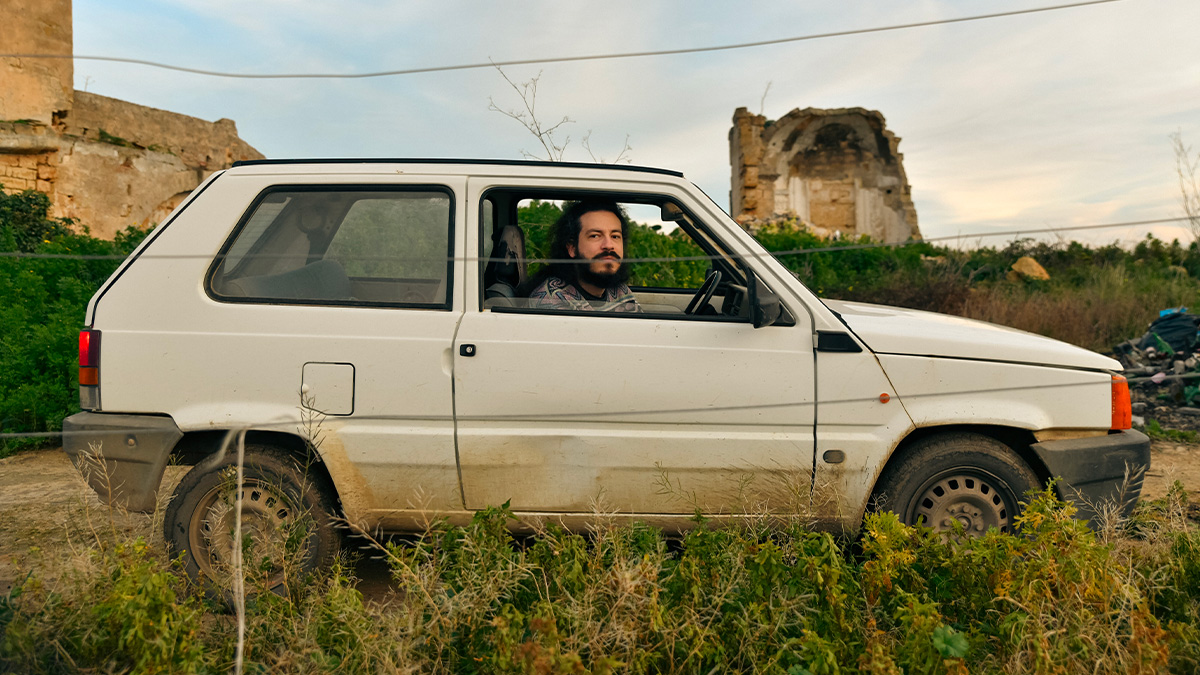
A job that moves silently in the arso hills from the sun of a province with a mystical breath, not far from the sea, where slowness becomes a form of resistance. A landscape dotted with loves and failures, parish parties with processions, electoral rallies, Hit Sanremese spread by a street vendor by bicycle, and wind farm forests that stand among the olive groves such as post-modern ghosts. In this scenario, which recalls the inner landscapes of Christ he stopped in Eboli, blowing warm winds of songwriting and electronics. Songs are born that tell a loved and hated reality at the same time, from which we distance each other to survive its monotony. “Bièsina“It is first of all a place of the soul, the starting point to tell an imaginative and suspended Sicily, almost unreal. The result of the solid artistic understanding between Waco and the manufacturer and multi -instrumentalist Fabio Gencothe EP is the result of a path of sound, narrative and almost anthropological exploration, which lasted a year and a half. The work intertwines Pop, Lo-Fi Rock, electronic music and suggestions that have roots in the popular, band and orchestral world, giving shape to a personal, authentic and deeply rooted musical language.
“Bièsina ”moves between reality and imagination. What is the link between personal memory and artistic creation for you?
Memory always plays a decisive role: not so much as a set of experiences, as for our tendency to give the latter an emotional value and identity, making them unique. For me, the link between memory and artistic creation lies in desire: that of transmitting – as easily as possible – this uniqueness to the listener, by any means, musical or textual, trying to make it fulcrum of any creative process.
In “Ciauro” you choose to use the Marsala dialect, rough and not tame. How important is the linguistic choice as aesthetic and political gesture today?
Writing in dialect involves risks: in its sincerity, it does not leave much room for style exercises with purely aesthetic purposes. For this, at the base there must always be a sincere motivation, almost a justification, to use it. In my case, in addition to wanting to maintain some intact content in their venance, I realized how the Marsali, with its hardness, attributes to these surreal scenarios a sort of sacredness, a dimension between the mystic and the dreamlike, which in some ways reminds me of the Sardinian. Of course, writing in Marsalese is a bit like moving on the rocks, but once the support points have been found, paradoxically in its most rough phonetic peculiarities, it is not difficult to lay it on the melody. It is a political gesture for the identity value that such a choice can have for a real linguistic minority like ours.
Between Synth with oriental shades, band choirs, lo-fi and bass rods, how did the production process develop?
A certain factor was my progressive approach to electronics, in a conscious and rational way, which expanded the wealth of resources in the context of writing. I owe so much to Fabio, my producer, from whom I learned not to become too attached to the details, to have the courage to conquer a choice when it is forced or not very coherent. We had no idea of the type of sound we wanted to give to the EP, the intention of uniting the pieces came out of the way. We focused on one song at a time. Some pieces came out of the jet, others from very tiring gestations. The common thread was the search for an organic sound, with particular attention to an electronics that we wanted to make as much as possible alive.

Your characters often seem to live in a state of suspension, between immobility and unfinished dreams. Do you think that “Bièsina” can also be read as a generational redemption or a form of testimony?
Certainly it can be read as a form of testimony, a signal that comes from a parallel dimension, but at the same time distant. From a cynical and fast world, like today. A reassuring message for those in the middle of this chaos are looking for a refuge.
“I would like to sleep” closes the EP with a tone that seems closer to the conscious yield than to hope. Does this work tell a return or departure?
In reality, hope lies precisely in the existence of a potential alternative life scenario and I am sure that in the future many people will decide to return. But here, perhaps more than a return, the EP represents a departure. To hook to “I would like to sleep”, it is clear that in some way, made baggage of joys and disappointments, it is necessary to understand whether to accept conditions or to aspire to something else. In both cases it is always a departure, a “moving” towards something.
It is evident for us, but we would like to hear it from you: how does Sicily go through your work? And how does this EP from a “local” dimension emancipates?
It crosses her with its sincerity, with its irony, with its cynicism and with its dusty images. The hinterland is then a very rich mixture of “microcultures”. Exhabating only the coastal area is a bit like praising the praise of the edge of a pizza, snubbing the center. Instead, he emancipates himself into the sound, in the strength of a mood that breaks down every type of cultural barrier and in the themes that, however, children of an introspective point of view, always maintain their universality.
Daniel D`Amico for SANREMO.FM
