
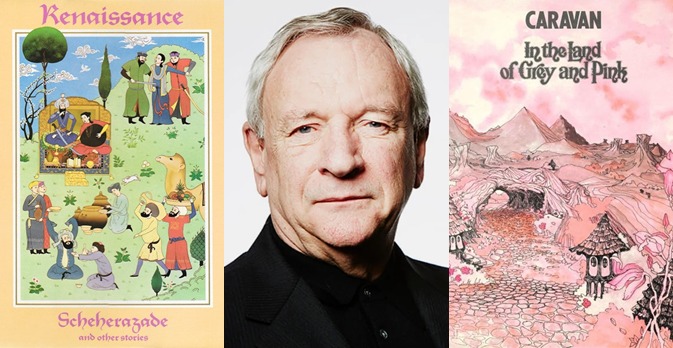

There are producers who make the history of popular music and become famous among any fan. There are others who, despite participating in very important albums, are lost in the folds of history: David Hitchcock is the perfect example.
The news of his death, which occurred on January 8, was given only by sites maintained by fans of bands he produced: Genesis News and Marko's Marillion Museum. No major newspaper was interested in it.
Never listed among the greatest, never taken into analysis when the creative use of the recording studio is celebrated, almost never interviewed by researchers, documentarians and journalists, it is difficult to even find photos of him on the Internet: the few available are all recent and belong to the period in which he moved away from music to enter the world of management and financial consultancy, not exactly the most attractive profile, in terms of character epic, for those who have in mind the story of a Brian Eno or a Phil Spector.
Even on the date of birth there is only one source: an interview with him for CoCaCamp, a site dedicated to Caravan, in which he states that the album “In The Land Of Gray And Pink” was released on his twenty-third birthday, which leads us to deduce that he was born on 8 April 1948.
His approach to studying was not monolithic and depended on the group he was dealing with. His greatest clients were the Caravan, the legendary Canterbury group: according to their interviews, Hitchcock pushed them to play live in the studio, rehearsing and rehearsing the various parts until they were perfect, but it was rarely the entire song. Often he required only one section, which he would then glue to the others by manipulating the ribbons. He tended to avoid overdubs, except for some particular solo or bizarre effect achieved in the studio.
On the contrary, for Camel he often resorted to it, recording the parts separately also due to decisional conflicts between the band members, and during the sessions of “The Snow Goose” he even created a tape to send loops almost ten meters long.
In any case, he was known as a producer who required a lot of work from the musicians: some were happy with it, obtaining excellent results (the Caravan keyboardist, Dave Sinclair, recalled how difficult it was to please him, but also how much his approach stimulated them creatively) and those who were not at ease (Tony Banks of Genesis did not appreciate the production of “Foxtrot” at all, and perhaps rightly so: compared to the results that Hitchcock obtained for other giants of progressive rock, that album did not boasts a production that lives up to its myth).
Hitchcock produced several other cult bands of the time, but essentially his legacy is linked to three prog milestones: Caravan's “In The Land Of Gray And Pink”, Camel's “Mirage” and Renaissance's “Scheherazade And Other Stories”, all deeply influenced by his studio work, with a sound that was sometimes delicate and melancholic, sometimes full and majestic.
After producing Marillion's debut EP, “Market Square Heroes”, featuring the suite of the cult “Grendel”, Hitchcock abounded in his activity as a producer and his distance from the scenes effectively hindered his possibility of entering the mythology of rock. This article aims to remedy this distortion, in its own small way.
Among the sources used:
David Hitchcock interviewed by Tony Rigg and Ewa Mazierska
David Hitchcock interviewed by CoCaCamp
In the Land of Gray and Pink, by Caravan (from the Music Aficionado blog)
Mike Barnes' Deram retrospective for Louder Than Sound
01/13/2026
Daniel D`Amico for SANREMO.FM