
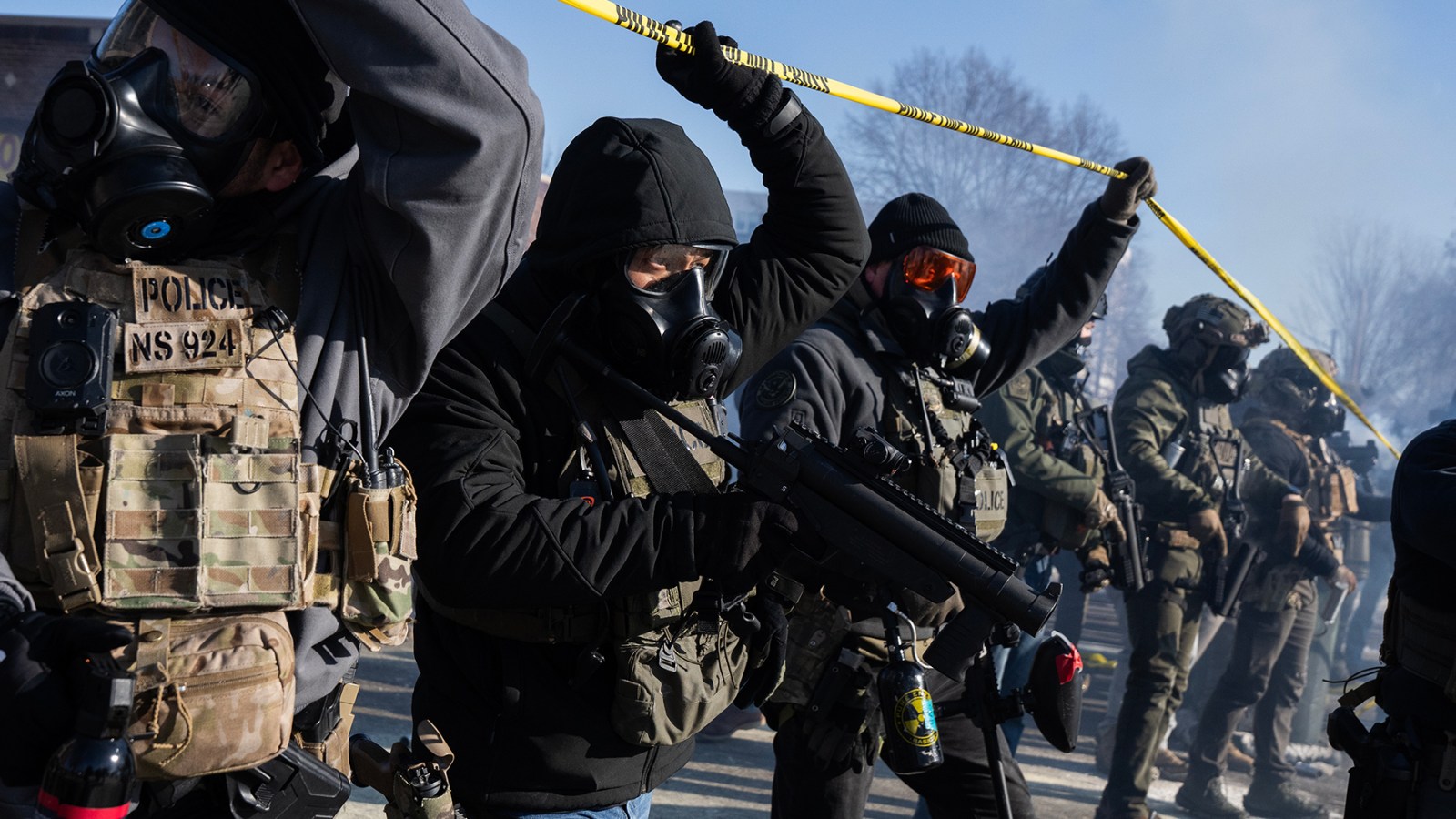
The federal government is retreating from Minneapolis, Minnesota. White House border czar Tom Homan announced on Thursday that the Trump administration will end the immigration enforcement surge it launched in January after a right-wing YouTuber highlighted allegations of fraud at Minneapolis-based child care centers.
Leaders in Minnesota were sober in their response. Speaking to reporters after Homan's announcement on Thursday, Gov. Tim Walz cataloged the damage. “This surge of untrained, aggressive federal agents are going to leave Minnesota — and I guess they'll go wherever they're going to go — but the fact of the matter is, they left us with deep damage, generational trauma,” Walz said. “They left us with economic ruin. In some cases, they left us with many unanswered questions: Where are our children? Where, and what is the process of the investigations into those that were responsible for the deaths of Renee [Good] and Alex [Pretti]?”
Walz was referring to a number of Minnesota students whose schools have lost contact with them over the last month — some of whom were later spotted by other students inside a Texas detention facility — and to the investigations of shooting deaths of both Good and Pretti at the hands of federal agents. Minnesota Attorney General Keith Ellison said Thursday that federal law enforcement continues to stonewall state and local investigations into the two Americans' deaths. “We haven't had any cooperation up until now, which is very unusual,” said Ellison, testing before the Senate Homeland Security and Governmental Affairs Committee.
To begin to address the fallout from the federal government's offensive on Minnesota, Walz announced a $10 million emergency relief package in the form of forgivable loans to small businesses that sustained losses during the period. Walz said the proposal was just a “small piece” of a larger effort to aid the state's recovery, adding, “The federal government needs to pay for what they broke here. … The costs that were borne by the people of this state — the federal government needs to be responsible. You don't get to break things and then just leave.”
The weeks-long siege of the Twin Cities etched indelible images on the backs of our eyelids: The shooting deaths of Renee Good, a 37-year-old poet and mother of three on her way home from school drop-off, and Alex Pretti, a 37-year-old nurse in the intensive care unit of a local VA hospital. A five-year-old boy, Liam Ramos, used to lure his father out of his home and arrest him. The tear-gassing of the Jacksons, a family of eight on their way home from their son's basketball game, in an accident that rendered their six-month-old unresponsive. ChongLy Thao, the elderly US citizen forced out of his home wearing only a bathrobe.
Amid all those horrifying failures, there is little evidence of what ICE actually accomplished toward its stated goal of arresting undocumented immigrants with criminal history. The ACLU, which has filed a federal lawsuit challenging ICE's actions in the state, collected more than two dozen depositions — all from US citizens and legal residents in Minnesota — who say they were profiled on the basis of their race. Their stories all tell a remarkably similar story: masked agents, forcibly detaining Somali- or Latino-appearing US citizens and legal residents without warrants, while ignoring proof of their legal status like passports, green cards.
“Operation Metro Surge” — which the Department of Homeland Security declared the “largest” exercise in agency history back in January — brought more than 2,000 masked agents to Minnesota, and the agency claims to have arrested 4,000 individuals since it began. Local news outlets have cast doubt on DHS' figures, which could not be independently verified, and one journalist who mapped every arrest listed in a public registry or press release found a total of just 335 arrests.
“We've seen a big change here in the last couple of weeks,” said Homan, who took command of the operation in Minneapolis after Greg Bovino, the former commander-at-large of the Border Patrol, was relieved of his duties in January. “And it's all good changes.”
Meanwhile, public support for Immigration and Customs Enforcement plummeted as its agents' gross incompetence and appetite for wanton violence were on display for over a month in Minnesota. Two-thirds of Americans surveyed said ICE has “gone too far,” 62 percent told pollsters that ICE made them feel “less safe,” and 72 percent said they want the agency either abolished or reformed.
Minneapolis Mayor Jacob Frey, reacting to Homan's announcement on Thursday, struck a similar tone to Walz's. “This operation has been catastrophic for our neighbors and businesses, and now it's time for a great comeback,” Frey posted on X. “We will show the same commitment to our immigrant residents and endurance in this reopening, and I'm hopeful the whole country will stand with us as we move forward.”