
_1745861084.jpg)
When it comes to contamination between electronic music and popular traditions, the risk of the sound postcard, tourist pastiche or instrumental folklorization is always around the corner. But there are rare cases in which the encounter between apparently distant codes reveals an unexpected proximity, an underground relationship that only awaits to be brought to light. This is the case of Folktronica, a Apulian collective project that emerges as one of the most interesting proposals in the panorama of Italian research music.
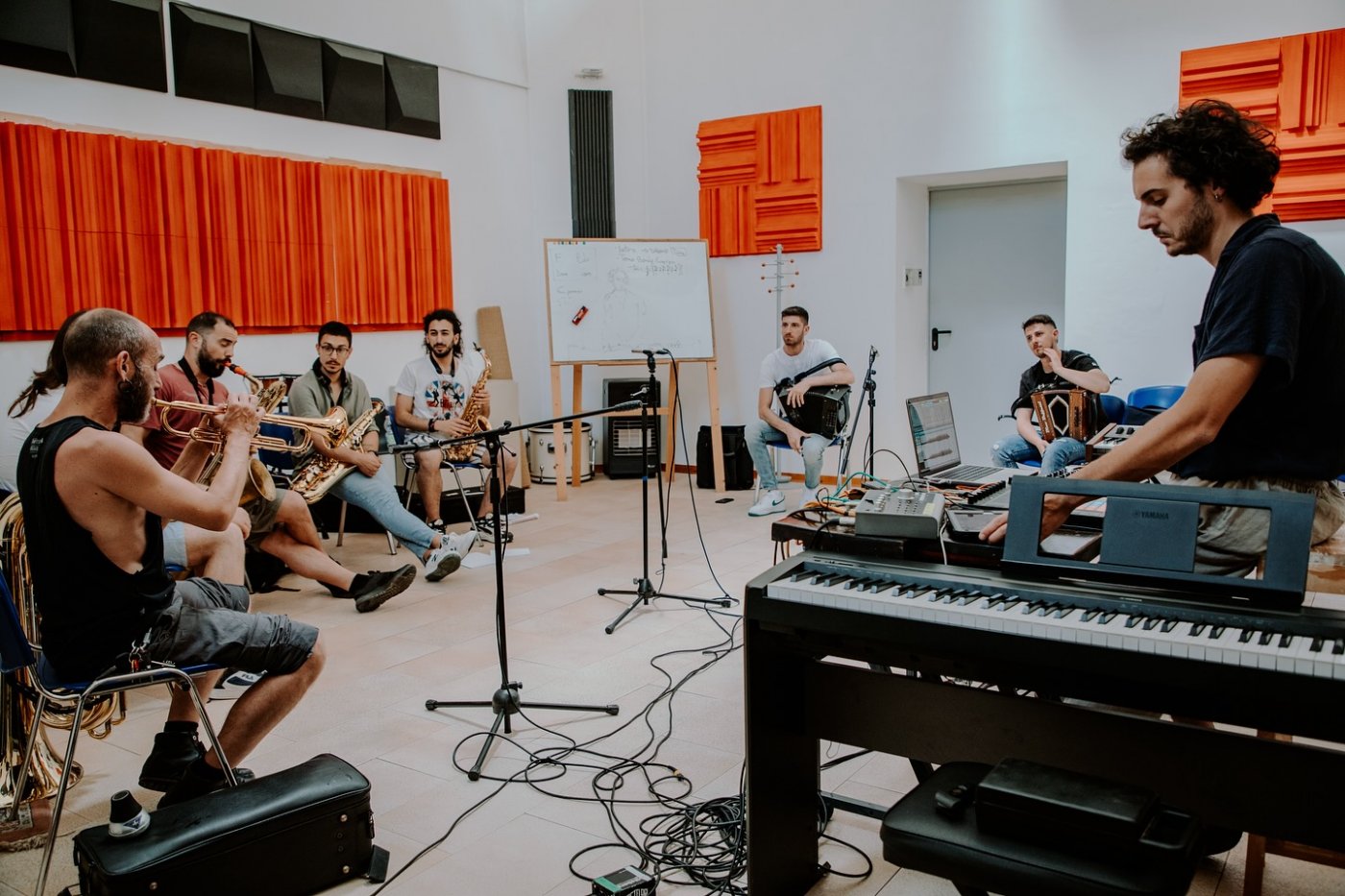
Born in 2021 from the meeting between World Music Academy and Last Floor Studio – two Brindisi entities engaged respectively in the preservation of traditional languages and in contemporary electronic production – Folktronica presents itself with four tracks which are the outcome of a four -year process of workshops, artistic residences and sessions in the studio. Not a simple record project, therefore, but a real anthropological laboratory that has put in dialogue generations, languages and apparently irreconcilable executive practices.
The peculiarity of this operation lies in its procedural approach: young producers and traditional musicians (including Emanuele Licci, Roberto Chiga, Livia Giaffreda, Go Dugong and White Ear) have worked together with field recordings, samples and loop techniques, applying them to timbre and rhythmic structures that belong to the collective memory of Southern Italy. The result is surprisingly organic, distant from the “World Fusion” operations that characterized the 90s and closer to the Label approach as sublime frequencies or discrepants.
The four tracks, which will be published individually starting from May 16, draw a sound map that extends from Salento to the eastern Mediterranean and North Africa, revealing timbre, scalar and rhythmic connections that simple geopolitics cannot contain. “Nespole”, “Battelli d'Ori”, “Diavulu” and “Irla na su po” are not philological exercises or laboratory experiments, but contemporary rituals where digital technology amplifies, rather than dissolving, the community power of popular music.
As Vincenzo Gagliani points out, Tambourist and curator of the project together with the producer Trevize and the musician Giovanni Chirico: “If we are at the idea of popular music as something that has to do with the encounter, with the rite, with dance, then it is natural to go and look for it and find it today in electronic music”. An intuition that reveals the profound continuity between the percussive trance of pizzica and that of electronic dancefloor, both spaces of body liberation and collective connection.
What distinguishes Folktronica from other similar projects is its educational and procedural dimension: the workshops have also involved trainees of the Tchaikovsky Conservatory of Nocera Terinese, offering young musicians the opportunity to confront an idea of living, non -museal tradition. An approach that reflects a central idea: tradition is not a repertoire to be preserved but a language to speak, a code to be questioned continuously in light of the present.
The choice to publish the songs individually, rather than in an organic album, reflects the open nature and in the making of this sound experiment, which promises to continue with new workshops and collaborations. In an era in which digital ethnography and cultural hybridization processes move at exponential speed, Folktronica stands as a privileged observation point on the transformations of Mediterranean folklore in the era of digital reproducibility.
Daniel D`Amico for SANREMO.FM