
“I feel like M.I.A./I got the freedom to create,” the adolescent boy chirped, pacing in circles and staring out at distant cityscapes, not looking very free. A little over a year ago, when Feng’s “M.I.A.” video came out, his songs were moody sketches of youth and yearning, custom-made for Instagram Reels. The boasts sounded more like coping mechanisms: Affirmations arising in lonely hotel suites, the kinds of places where people are sadder than they seem on Instagram. Maybe, when M.I.A. sees a certain name pop up on her phone, she, too, paces in circles, pinching her forehead. “Ok, who is Feng?” she recently asked. “Feng is always hitting me up. Why is everyone obsessed with Feng?”
Feng is a 19 year-old rapper who resides in London, but spends lots of time in Los Angeles, where the laid-back swagger of last decade still lingers. It was in L.A., last year, that the subject of “Left for USA,” from his slight debut mixtape, found a new, appealing life: “Hollywood Boulevard, he must be living great/I’m stuck in London, that’s why everything look gray.” Not for long. Feng—who recently struck a major-label deal—makes coast-hopping music, and will soon be making coast-hopping money, too. (Another “M.I.A.” lyric: “Gettin’ fly like planes/I went from London to L.A.”)
No score yet, be the first to add.
But somewhere beneath his swag-era escapist pastiche lies a latent longing. This is partly why everyone is obsessed with Feng: not only is he constantly between two continents, but two competing sensibilities, a clouted optimist who’s mastered the moment before the comedown. His strongest songs are sometimes his briefest, and squeeze youthful extremes—love and lack, ecstasy and ennui—into YouTube Shorts for slack-jawed screenagers. He is, at best, a conflicted rapper for a conflicted generation, giggling through short-form loops, grunting through this long-ass life.
Few Feng songs articulate this quite like “Left for USA,” which looks across the Atlantic, dreaming unattainable dreams. Unfortunately, “Left for USA” is also uniquely self-fulfilling: On his dull debut album, the rapper indeed ditches dreary London, and with it, the nuance that made him interesting. Weekend Rockstar bludgeons its beloved 2010s indie dance-rap to death: brute-forcing the sunwashed sound, stuffing in belabored references, and all the while sounding surprisingly uncurious, as if last decade should be paying him royalties for the exposure. No longer slouching on lonely rooftops or suspended between inchoate feelings, Feng would like to re-introduce himself: “I’m young and I’m lit and I’m cruisin’ in the whip,” he drawls on “Teenage Famous,” a half-assed L.A. anthem too profane for the high school DJs in Radio Rebel, but perfectly on par with the movie’s third-grade audience. (Begins the chorus: “How do I say this? I’m teenage famous.”) It is one-dimensional music at odds with a precociously worldly teenager, whose rapidly changing life yields confusingly little growth.
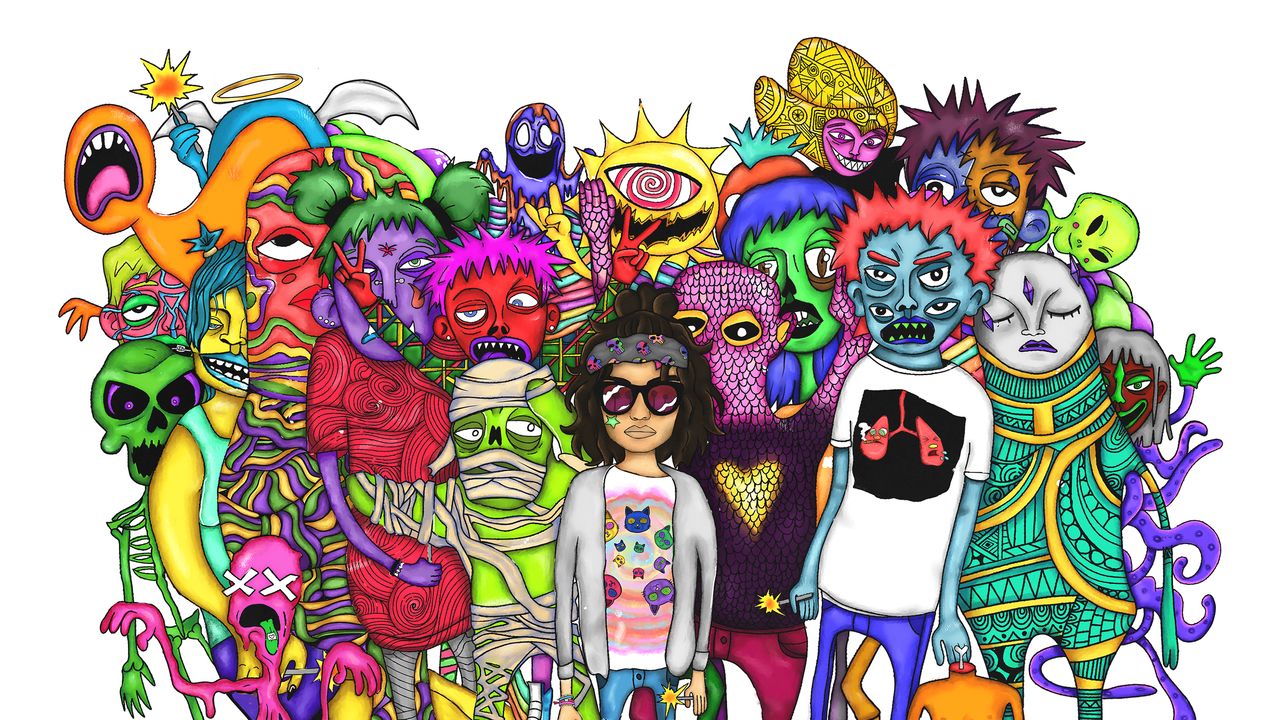
As a “positive punk” who “wears colors,” Feng seeks to subvert—spiritually and sonically—the “gray” London he’s left behind. Like a Crayola set melting in the Los Angeles sun, Weekend Rockstar bleeds with garish pastels: consider the gauzy stomp-clap of “Cali Crazy,” or the corn-syrup stupor of “F’d Up,” or, if you’re having trouble sleeping, the cerulean slow-dance of “Superstar.” There is a fine line between “color” and oversaturation, and an even finer one between oversaturation and shitty HDR. By blowing past them all, Feng has proven, ironically, that the murkiest grays are no worse than the gaudiest hues—and if his native underground is any indication, those murky, uncertain grays are often much more interesting. London rap, circa 2026, is a patchwork of young, conflicted characters: sleepwalking through half-remembered swag eras, hoisting camcorders at bloghouse bile, scoring splintered identities with splintered musical palettes. The coolest hip-hop coming out of the UK is complicated. Unfortunately, Feng is too cool for that.
Daniel D`Amico for SANREMO.FM
