
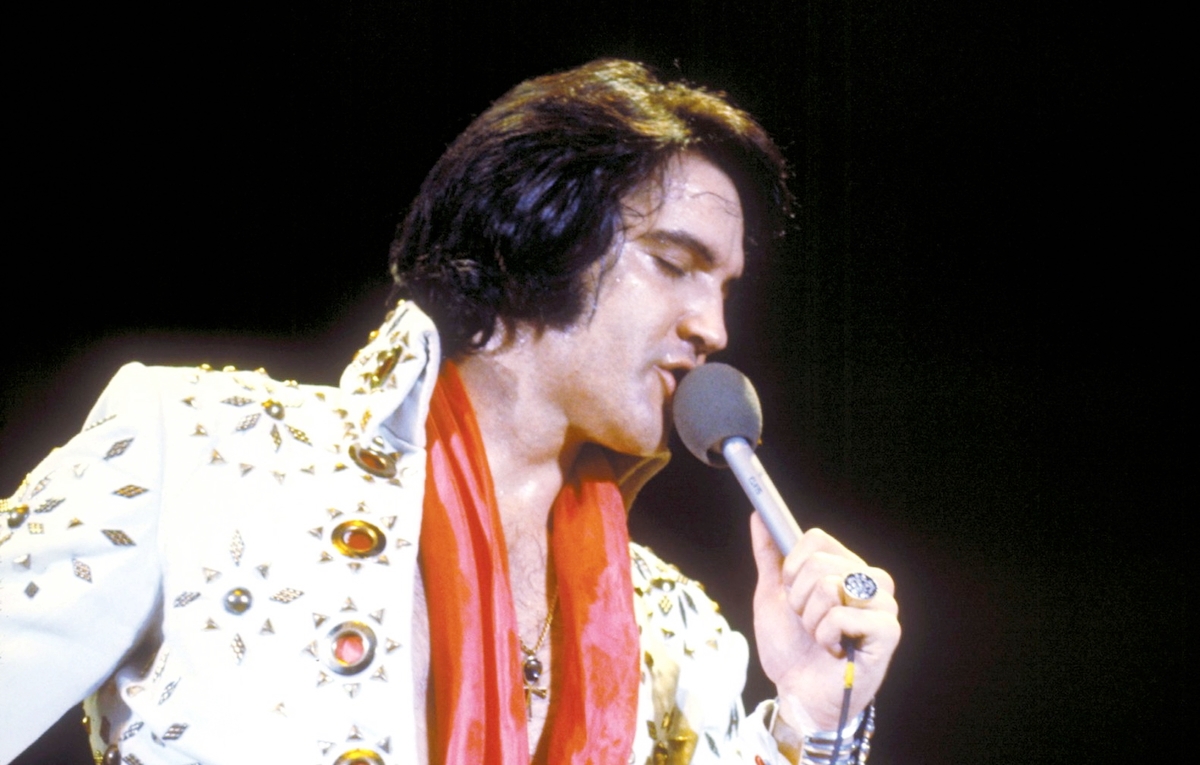
The Holy Grail of Elvis Presley are ten professionally filmed concerts in the early 1970s. For half a century they remained locked in the depths of a salt mine in Kansas. Even to the most avid fans, the existence of those reels was little more than a legend. Then came Baz Luhrmann. When he signed the contract to direct the biopic Elvis he demanded that Warner Bros. take out the 59 hours of film he owned, to see if they could somehow inspire the film.
He was amazed by what he saw. It wasn't just Elvis at the top of his talent as a performer filmed from multiple angles, often by expert filmmakers. There was also backstage footage and informal interviews with someone who gave little of himself to the press. “That stuff couldn't go back into the salt mine,” Luhrmann says via Zoom while walking through the streets of Tokyo. “We had to do something about it.”
That Something wasn't supposed to be a traditional documentary about Presley's tours. It had to be bolder, it had to be “a symphonic poem”, as the director calls it. “It's as if Elvis appeared to you in a dream and sang you his story.”
The result is EPiC: Elvis Presley in Concertfrom March 5th in Italian cinemas. Adapting those films for the big screen posed great technological and financial challenges, even though the films had been stored in the salt mine to protect them from the damaging effects of humidity. The recovery process began when Luhrmann and editor Jonathan Redmond began rummaging through boxes of reels shot for the 1970 documentary Elvis: That's the Way It Is and for the 1972 concert film Elvis on Tour. “We took them to the editing room at Warner, there was such a vinegar smell,” Luhrmann recalls. «It's the typical smell of degrading film. He was very strong, we understood that he was about to unravel.”
Once the delicate digital transfer work was completed, the director realized that the material available was spectacular. There was a problem, however: much of the concert footage was without sound. RCA had multitrack tapes of each show, tapes that were then synchronized with the images. While searching for other audio material we came across a previously unknown 45 minute interview conducted by the team at Elvis on Tour in 1972, with the camera off. “You sense that Elvis is tired and vulnerable,” Luhrmann says, “but he talks about his life candidly.”
From the discovery was born the idea of making Elvis the narrator of the film, using that interview and other fragments of conversations recorded on other occasions. «His story has always been told by others. Even those who filled his car with gas or looked him in the eye just once wrote a book about him. This is his version of events.”
EPiC begins with a fabulous segment of the medley An American Trilogy from 1972. We move on to collages of television appearances from the 1950s and the first concerts filmed by fans. And then the B-movies shot in the '60s, during the waning phase of his career, including one in which he sings to a dog-man. «The image that Hollywood had of me was wrong. I knew it and I couldn't say anything,” Presley says. “It wasn't anyone's fault or maybe it was only my fault, but I was doing things I didn't fully believe in.”
EPiC goes back and forth between 1970 and 1972 with out-of-the-ordinary interpretations of Bridge Over Troubled Water, Suspicious Minds, In the Ghetto, Burning Love And How Great Thou Art. Redmond, the editor, was concerned about this “jumping back and forth in time and space, due to different aspect ratios and formats. One shot is in super-8, the next is in anamorphic 35mm, then 16mm in 4:3.” In the end they followed their instincts. «We weren't interested in a linear flow».
To make the images stand out they entrusted them to Peter Jackson's New Zealand team, the same one from the Beatles documentary Get Back. «They set the standard for film restoration: cleaning, recovering, removing every speck of dust without losing anything, because you can overdo it with restoration and when you do it it all looks plasticky», says Redmond. “They are masters at making film look… well, film, only better and cleaner.”
Luhrmann and Redmond also had concerts after 1972, including the 1977 television special, but Elvis' physical condition was precarious a few weeks before his death. “In 1977 his body was compromised,” says Luhrmann, adding, however, that his “spirit and voice were soaring high.” At the end of the 2022 biopic the director had already used a famous execution of Unchained Melody dating back to the same period and didn't want to go back to it. “We didn't want to repeat ourselves and we didn't want to show it at the end.”
The film ends by recalling that Elvis performed over 1,100 concerts between 1969 and 1977, at times as many as three a day. “He flew too close to the sun,” says the director. «And to quote one of his songs, he was trapped and was never able to get out. Even he doesn't know why, but the only thing that keeps him going as he continues to tour America, concert after concert, is the only love he can get and that's the love that comes from the limelight. Performing became his addiction.”
Now Luhrmann is working on pre-production on a film about Joan of Arc, but he's not ready to put Elvis behind him yet. A 1972 concert at Hampton Coliseum, Virginia has emerged from the archives. It has never been shown in its entirety and the director is considering turning it into a film one day. He is driven by the knowledge that his biopic has generated a wave of interest in Elvis among young people, many of whom previously barely knew who he was.
“It goes for all great icons: there comes a time when they end up in the background or become only good for Halloween costumes,” says Luhrmann. «But Elvis was a human being with a history of absolute poverty behind him. The parents could neither read nor write. And he suddenly becomes the most famous twenty-year-old on the planet. Nothing like this had ever happened. The idea of this film was not to interfere and to show you her most intimate side.”
From Rolling Stone US.
