
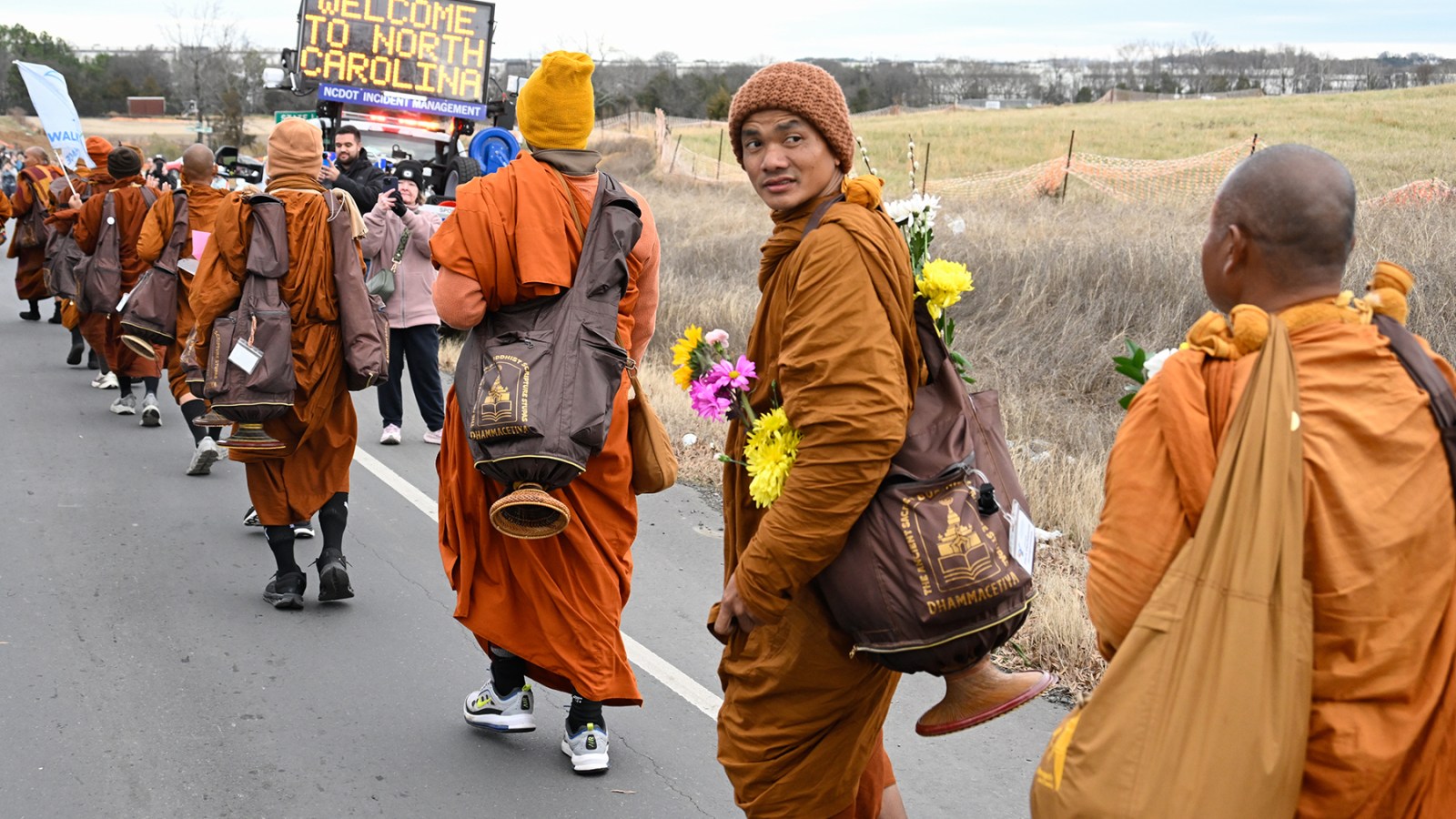
It was a sunny day in Lexington, South Carolina on Jan. 8, 2026, the perfect day for walking. Kristin Greene, who had traveled over three hours from her home in Raleigh-Durham, North Carolina, was visiting her parents following the holidays. In her down time, she'd begun scrolling Facebook and saw a post about a group of Buddhist monks walking past their neighborhood, headed to Washington, DC “I saw they were only going to be 10 minutes away from my parents,” says Greene. “I took it as a sign for me to go and see them.” For Greene, seeing the monks inspired hope for healing, both in her own life and within the country.
Since Oct. 26, 2025, about two dozen monks from have been on a pilgrimage, dubbed Walk for Peace, to spread a message of peace throughout the United States. Starting in Fort Worth, Texas and headed to the White House, where they expect to arrive on Feb. 10, the group — which consists of monks from around the world, along with an Indian pariah named Aloka — is led by Bhikku Pannakara, a former engineer turned monk. He started planning the 2,300-mile journey last March. Now, the monks walk in rain or snow with a team of support personnel by their side, who coordinate everything from their meals to their lodging at local hotels in the cities they visit. “Early last year, he started to spread the message to the monk community about wanting to organize a walk for peace,” says Chien Lee, secretary of the Huang Dao Vipassana Bhavana Center in Fort Worth and coordinator of the walk. (Pannakara was unavailable for interview.) “We had a group of monks respond to it. We have monks from Thailand, Vietnam, France and the USA. We've recently had a Burmese monk and a Sri Lankan monk also join.”
According to Lee and the monks' official social media pages — which have over five million followers between Facebook, Instagram, and TikTok — the purpose behind this walk is not for political messaging. “The reason we walk on that path is because we want to walk to all the state capitals to whatever state we can enter,” Lee says. “It's also the shortest path to Washington, DC but there's no political or religious motivation.” And while that may be true, for folks like Greene, it still feels like a spiritual encounter. On social media, thousands of users have offered prayers of safety for the monks in the comments, while sending information to one another regarding next locations and their personal experiences attending in their respective cities.

Bhikkhu Pannakara, the leader of the walk, on January 15, 2026 in Charlotte, North Carolina.
Sean Rayford/Getty Images
Greene, who grew up Christian in the South, feels aligned to the monks and their mission. Five years ago, when her sister died, she had been studying Zazen, a seated meditation practiced within Zen Buddhism. “Maybe my algorithm recognized my interests and kind of pushed it up to the front of the line for me to see what was going on with them,” Greene says. “This was super timely with everything going on in the country.” Greene, her son, and her parents joined hundreds of others and waited two hours for the monks to pass by. No one was discussing politics, instead arriving with flowers and snacks, standing around, exchanging stories of hope and their reasons for why they were in attendance. Greene brought purple carnations. “These are strangers but you know you're all there for similar reasons,” Greene says. “There was a lot of hope that was palpable in that air. Everybody had different stories for why they were there, but it all kind of streamed back to this feeling of hope.”
Despite the millions of people being invested in the monk's message, there's been pushback from more conservative groups. Over a dozen Christian protesters, both Black and white, have been trailing the monks to combat their message with signs that read “Jesus Saves.” It's unclear whether or not they all belong to the same church or affiliation, but their message is unified in that they believe the monks' walk is a religious movement, promoting Buddhism. In Georgia and South Carolina, several Christian protests came to the monk's location, with megaphones and signs, with some resembling MAGA flags, yelling that “Christ is coming to set you free.” They've also faced other obstacles. Nearly a month and 277 miles into their journey, in Dayton, Texas, two monks were hit by a car, resulting in one having his leg amputated.
Despite the chaos, Pannakara has been responding peacefully, with a message of unity. “We are not here to convert anybody or trying to persuade anybody to come with us,” he said in one TikTok posted in early January. “We are here for just one mission together: To have peace for our own, to have peace for this country and to have peace for this universe. We all believe in different faiths. We have different mindsets. But all of those religions are teaching us how to purify our minds and become a good person in our society. In the end, all these religions teach us to come back to one religion which is peace, love and kindness and compassion.”
Phra Ajarnh Maha Dam Phommasan lost his leg after being hit by a car in Texas.
Raquel Natalicchio/Houston Chronicle/Getty Images
Weissman, who has been living in Charlotte, North Carolina for over 20 years, heard about the monk walk from a good friend who is Catholic. When Weissman and her friend arrived in Fort Mill, South Carolina, just south of Charlotte, the crowd and the monks were led inside the visitor center for shelter and so the monks could eat their lunch. “When we first arrived there were maybe 150 people,” Weissman tells Rolling Stone. “As time went on, there were at least a couple thousand people.”
Things weren't entirely smooth, though. When a protestor showed up talking about Christianity and genocide in Sudan, Weisman had enough. “I started to hear what he had to say and it was like, 'Nope,'” says Weissman. “I am a reformed Jew and I'm a product of an interfaith marriage because my father was Catholic. I was raised Jewish, I was exposed to both and I was taught to respect both. I have no tolerance [for] people's hypocrisy.”
Although the monks' walk is not a direct commentary on politics, it coincides with a sense of ease spreading across the country. The day before Greene went to see the monks, Renee Good was shot and killed by an ICE Agent. Ten days after Weissman and her friend visited South Carolina, Alex Pretti was killed. If millions of people, all with different political affiliations and backgrounds, can agree there is a need for peace, how do we actually get there as a nation in a practical sense? “We believe that if our message goes to the capital of each state, along with the capital of the nation, that that message will propagate at a larger scale,” says Lee.
Lee tells Rolling Stone that upon their arrival to DC, the monks do not have any confirmed meetings with politicians although there are talks of a meet and greet at the Capitol. In the meantime, viewers like Greene and Weissman have been in a space of reflection regarding their time with the monks and their individual inner work moving forward. “It's eye-opening for me because I have been trying to learn more mindfulness, how to practice it and be more aware,” says Weissman. “I feel I can practice that in my everyday. We all need a little more of that in this world.”