
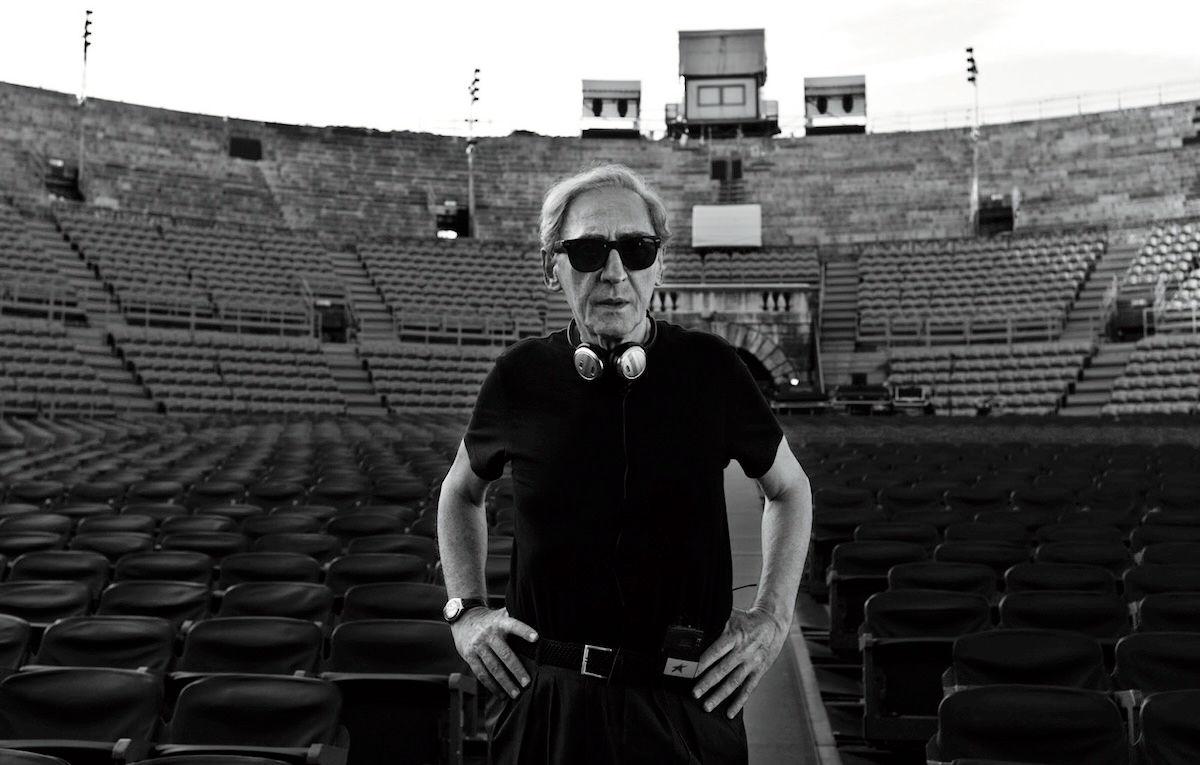
Accessing Franco Battiato's exhibition at the MAXXI in Rome means immediately accepting a somewhat cruel and very Battatesque pact: you will not understand everything, you will hear multiple things at the same time, you will want to stop and escape at the same time and, in the end, you will come out with the clear sensation that the music has once again played its chance of doing without the explanation of the music.
As soon as the threshold is crossed, the first curatorial gesture is also the most Battatesque possible: there is no straight line. There is a magnetic field. The sound installations work simultaneously, the sections with black and white and then color photos, the concert posters, the astrakhan hats all follow one another like vessels that are only apparently not communicating. What happens, museologically, is what already happened in his best records, where the tracks overlapped, the temporal planes collapsed, the verses of one song seemed like choruses of another.
Thus, at the National Museum of 21st Century Arts, the vinyls break through the space-time granted to the captions and the rooms echo each other as if they were orchestrated by a single great mind in constant activity. You have a hard time trying to follow the order of the visit, paying attention to an old RAI film in which Battiato responds to an interview by shaving and telling, with Sicilian Adrien Brody charm, that at the age of 7 he started studying piano, only to then get distracted by football; here it comes from a room further on, with arrogance I want to see you danceand everything is more confused and clearer.
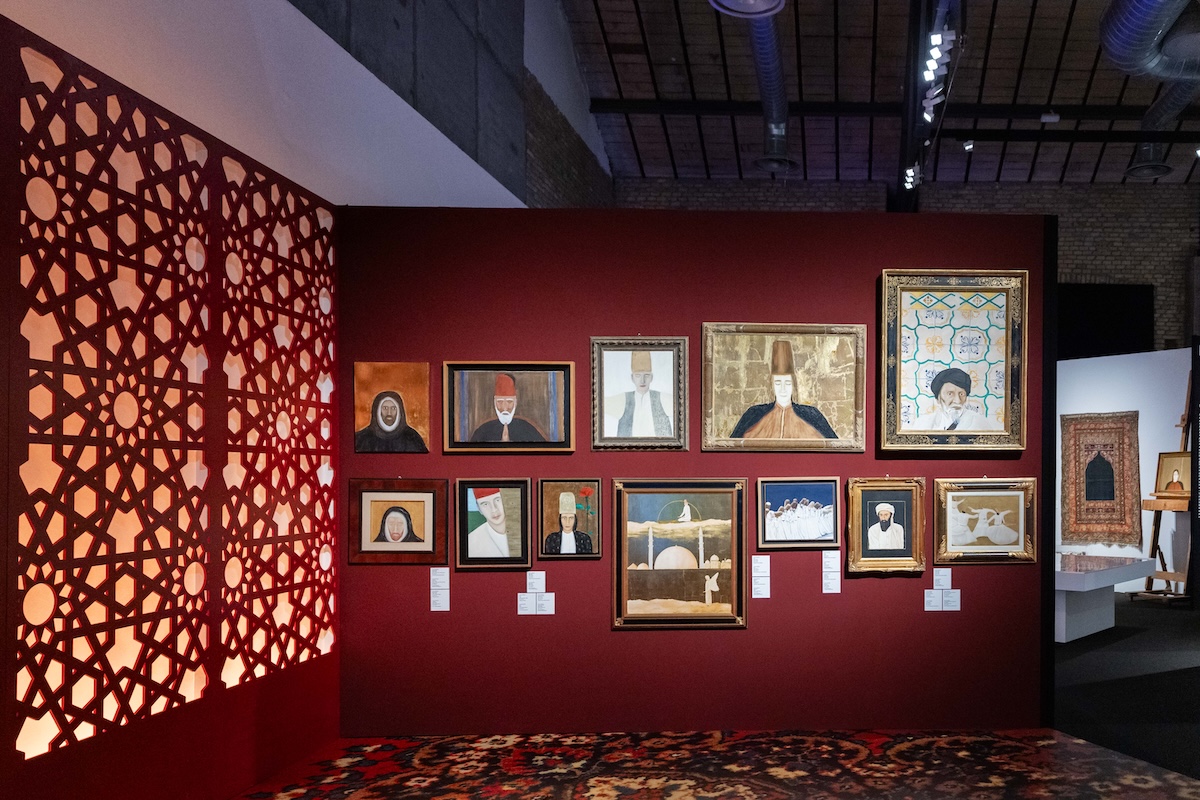
Photo: Cosimo Trimboli/MAXXI
The beauty of “Franco Battiato. Another life”, edited by Giorgio Calcara with Grazia Cristina Battiato, is that you don't understand everything. An audio contribution sometimes gets mixed up, sentences get lost, some stories become premonitions read backwards and, vice versa, certain youthful quotes can be read as epilogues ante litteram. But that's precisely where the exhibition really starts to work: the moment you realize that the misunderstanding is not a flaw in the display, but rather a form of extreme fidelity. Battiato, like few other multidisciplinary talents capable of crossing music, word, image and thought as if they were a single mother tongue, cosmopolitan and undisciplined, has never been fully explainable; and any attempt to reduce it to a timeline, a caption or a voice-over risks becoming immediately secondary to what really matters: the music put into practice, the painting displayed in a beach house, the physical vibration of sound, the idea that the work always precedes the narrative of the work.
Exposing yourself to sound, to superposition, to perceptive errors, to that slight dizziness that comes when too many things happen at the same time and you are forced to give up the idea of controlling them all. It's a rule that applied to his records, to his interviews, to his silences. And it is right that this also applies to an exhibition that, rather than telling it, tries to keep up with it.
The archive materials, the memories of the small and large characters who knew and accompanied him, the platinum record for The master's voicethey only apparently function as road signs for this journey. The framed platinum, in particular, is striking for its ambiguity: it certifies a sensational success and at the same time reveals its absurdity. Because Battiato was also this paradox: an artist who brought into the heart of Italian pop words, images and obsessions borrowed from mysticism, oriental philosophies, asceticism, inner discipline, spiritual research understood as a daily practice and not as exotic decoration or esoteric cliché, managing to make them coexist with memorable melodies, singable refrains and a mass success that never tamed him or made him harmless; because behind that apparent accessibility a restless, radical thought continued to flow, irreducible to entertainment. That shiny object, placed under glass, seems almost embarrassed to exist.
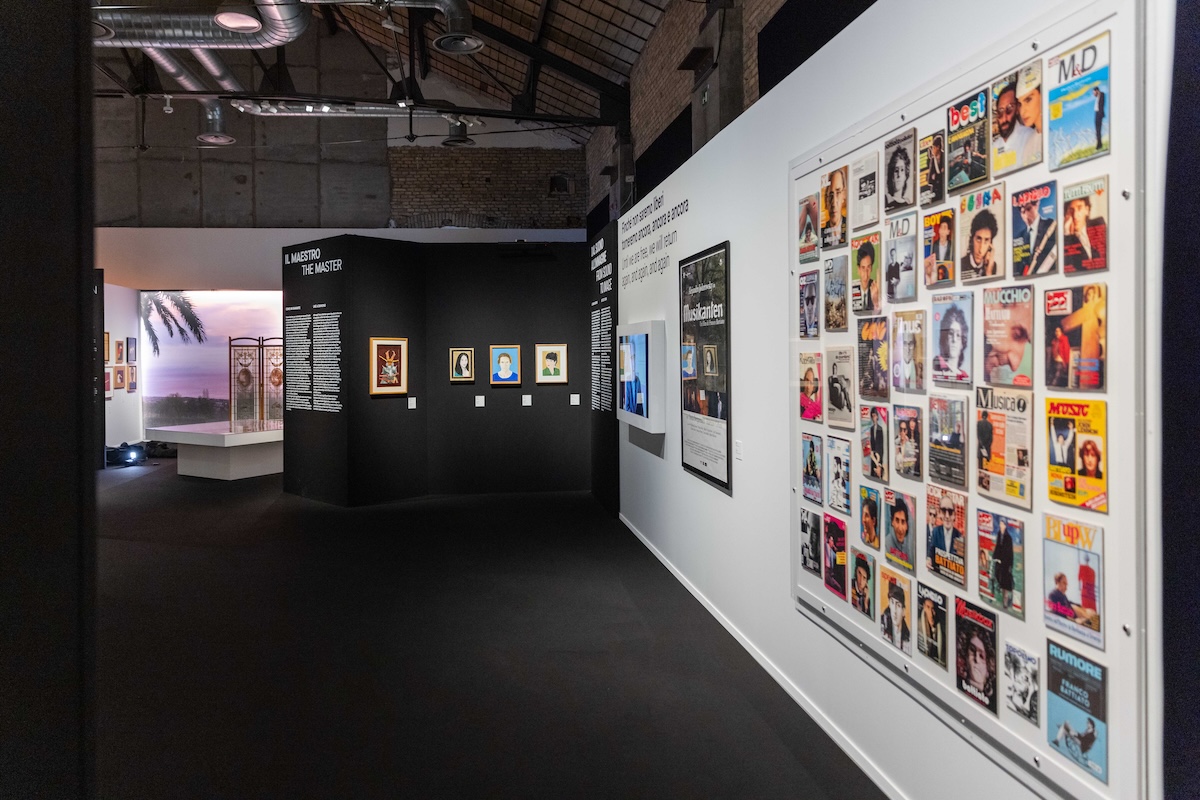
Photo: Cosimo Trimboli/MAXXI
One of the most curious panels of the exhibition is the collection of magazine covers. Blow Up, Rockerilla, Girl In, Linus, Mickey Mouse, Noise, XL, The Express, M&D, Tele Seven, the Brat. Seeing them all together doesn't speak so much of a career as of obstinacy: the continuous, almost obsessive need to explain who Battiato was. Decades of press that have chased him, questioned him, celebrated him, misunderstood him. Each cover attempts a different take, an angle, a formula. No one can really contain him. It's visual proof that Battiato has long been an open question rather than a multiple answer.
The exhibition does not fail to include a sequence of portraits which, at the climax, form a bizarre diptych: on one side the sublime Giuni Russo, on the other Rudy Zerbi. There is a video installation in which what Battiato could see from Villa Grazia in Milo, at dawn and dusk, is reproduced infinitely (or, at least, until April 26, 2026). There is a touching table that presents the collection of books that the artist kept closest to hand in the studio, from The language of birds to The mystery of silence.
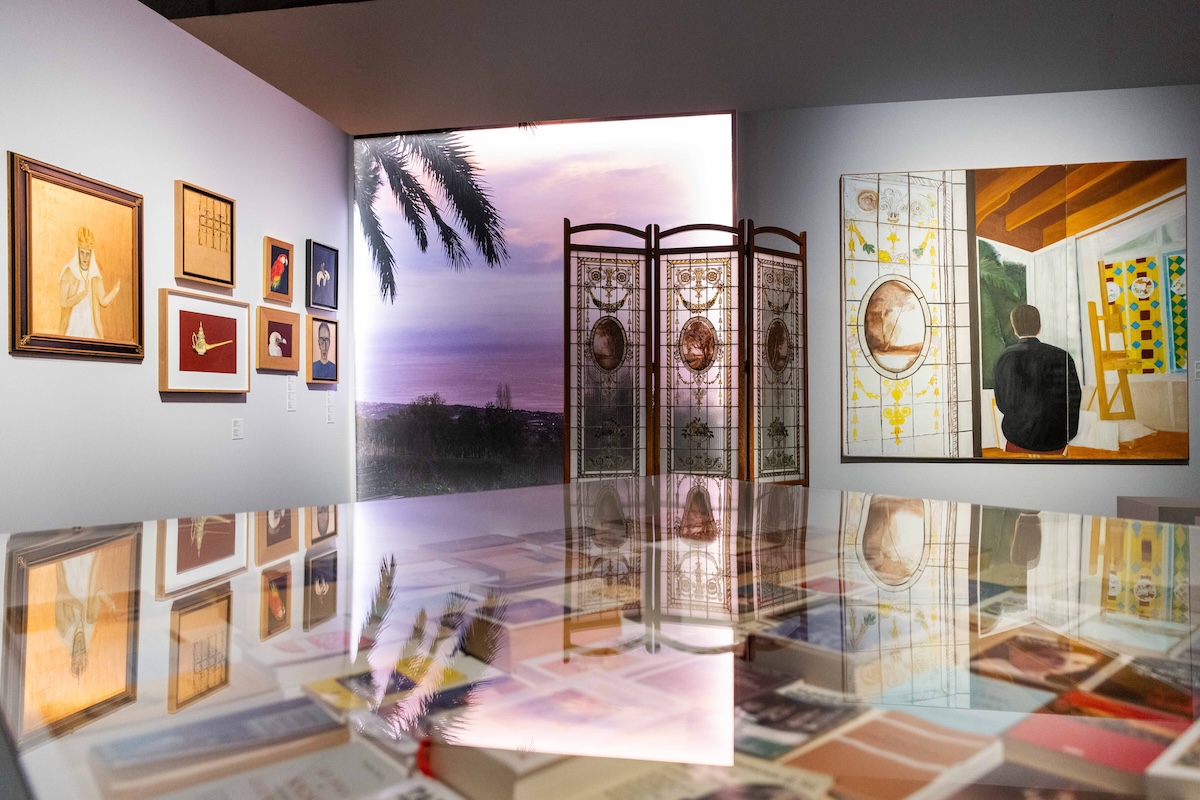
Photo: Cosimo Trimboli/MAXXI
But the most secret and revealing moment of the entire exhibition is the large triptych with the self-portrait painted by Battiato between 2000 and 2010. Not so much for what it shows, but for what it persists in not granting.
The artist has his back turned. There isn't that element of recognizability that transforms every self-portrait into an implicit request for attention. There is a firm and operational calm. The posture is that of someone who is working, or about to do so, and who has accepted the idea that identity is not something to be exhibited, but a position to be maintained with discipline. Battiato turns his back on us with a formative kindness, almost as if to say: I am not the subject, rather observe what I am looking at. And what he looks at is a divided, fractured space, broken down into panels as if reality itself were a rearrangeable score. On the left, a surface that recalls a majolica decoration, with a central oval that opens a small window onto a landscape: nature filtered by tradition, the world seen through a cultural device. On the right, however, the interior of the studio: an easel, some canvases, a window with colored glass that refers to an idea of art as construction, as declared artifice. Between the two worlds, him. Or rather: his back. In that transition area that has always been his home: between East and West, between sacred and profane, between composition and sudden illumination. Battiato does not place himself at the center to dominate the scene, but to cross it as a threshold figure, not as a protagonist.
The color also works in this direction: warm, domestic tones, woods, ocher, greens. It is an orderly world, but not a rigid one. Battiato is telling us that true asceticism, for him, was never the escape from the world, but rather the patient construction of a habitable space for thought.
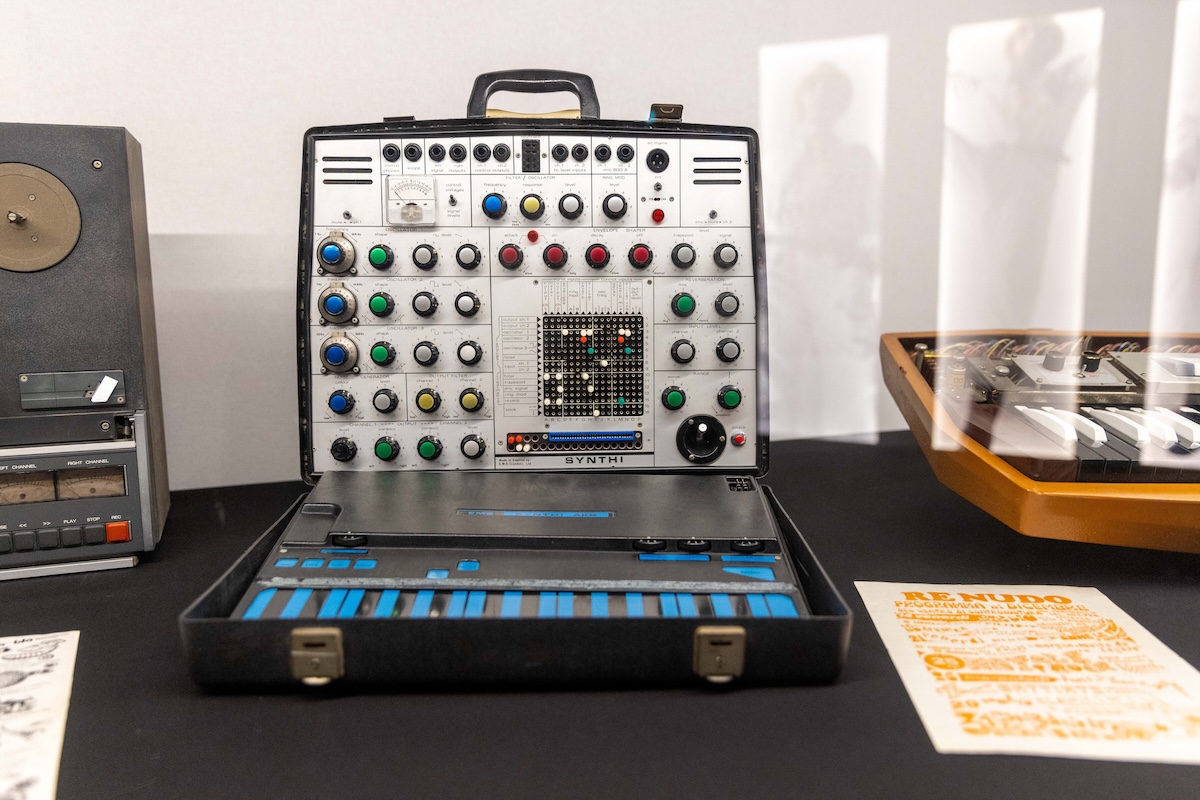
Photo: Cosimo Trimboli/MAXXI
In the middle of the exhibition space there is an octagonal room entitled “Permanent Center of Gravity” in which five of Battiato's most famous songs, from White flag to No Time No Spaceamplified by countless Dolby Atmos speakers aligned and calibrated with military precision, overwhelm the visitor without escape or shelter. Here is the source of distractions mentioned above. After going through biographies, images, words, notes, music finally takes command and puts everything back in its place. Characterized by a light musty smell (which, of course, does not smell of neglect but of concentration, of restrained intensity) this room shares the soul of adult homes that have not lost the scent of youthful homes where one reads a lot, listens a lot, thinks a lot, before explaining to the world that, in terms of permanent centers of gravity, it is important to continue looking for them, even after 45 years but, above all, it is even more important to never find them.