
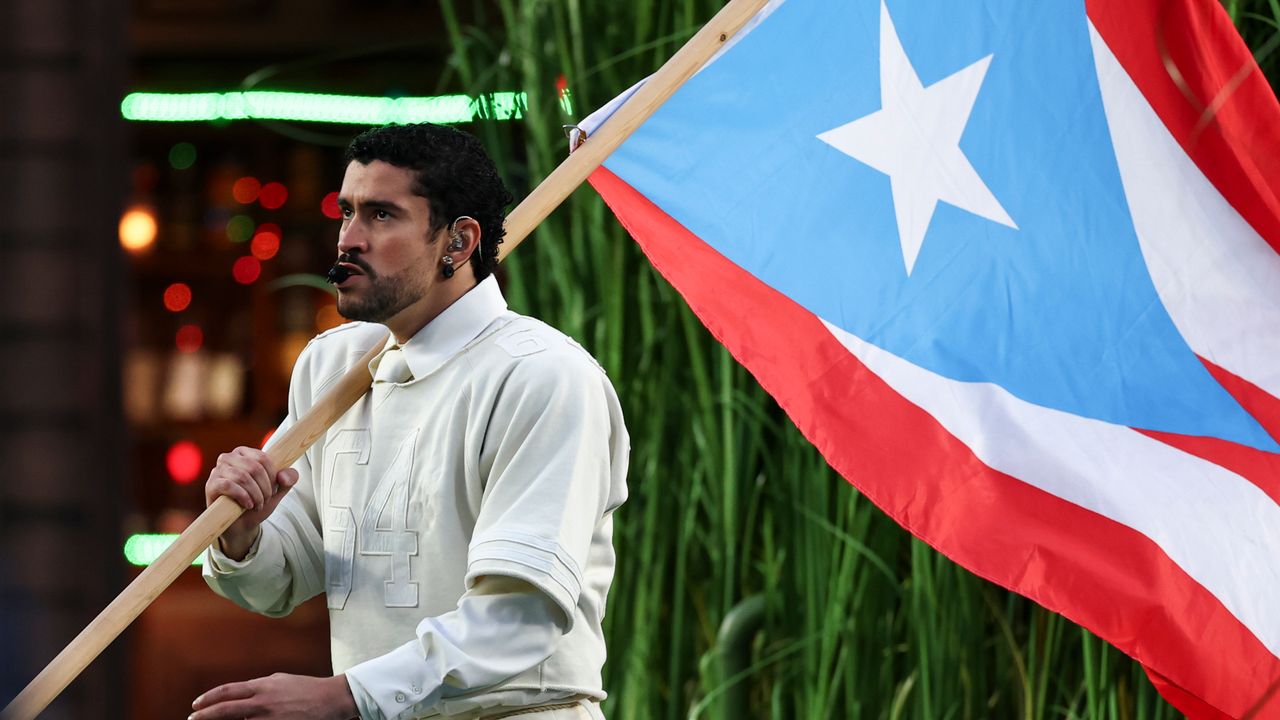
Backup dancers, some dressed as grass and others in head-to-toe Puerto Rican jíbaro regalia—traditional all-white clothes topped with a straw pava hat—crowded the stage. The iconic pink casita that has played a central role in Bad Bunny’s Debí Tirar Más Fotos live show was being put together. The man himself was rubbing his hands together, hyping himself up as all around him a miniature Borikén was being built in the middle of Levi’s Stadium in San Francisco, transporting him back home before bringing the flavor of his island to the world yet again.
Pre-show reports of Bad Bunny’s long-awaited Super Bowl halftime show said it would be a “big party”—and it was. The man of the hour appeared in an all-white jersey emblazoned with “Ocasio 64” and opened with Un Verano Sin Ti standout “Tití Me Preguntó.” He ran through the grass toward the casita’s rooftop, running into boxers, baddies at a makeshift nail salon, a piragua stand, and a jeweler who gave him a ring, which he promptly gave away to a dancer: “Muchacho deja eso” (Man, leave that).
The perreo medley raged on, mashing together hits from across Bad Bunny’s discography, including “Yo Perreo Sola,” “Safaera,” “Party,” “VOY A LLeVARTE PA PR,” and a nod to OG marquesina parties that featured bits of songs by Daddy Yankee and Tego Calderón before seguing into “EoO.” After violin-tinged “MONACO,” he looked into the camera and almost whispered to the viewer: “Nunca deje de creer en mi, y tu tambien deberias creer en ti.” He never stopped believing in himself, so maybe you should believe in yourself.
Bad Bunny’s massive global fanbase is drawn to this authenticity. With 19.8 billion streams in 2025 and a historic Grammy win for the first Spanish-language Album of the Year, keeping it real has meant downing Smashburgers and having his therapist on speed dial. It wasn’t Bad Bunny’s first time on the field (real ones remember Benito in an all-silver getup playing second fiddle to Shakira during her co-headlined Super Bowl performance with Jennifer Lopez six years ago), but Bad Bunny’s headlining slot for Super Bowl LX was the first time in the NFL Championship’s 60-year history where the main performance was done entirely in Spanish.
Talking to Zane Lowe on the Thursday before, wearing big sunglasses, a gray fur coat, and a bunny-eared beanie, Benito seemed visibly tired. He said he wanted to think of this latest career milestone, performing on the most-watched TV event of the year, as “13 minutes doing something that [he loves].” It’s a sweet way to process the moment, and it showed in how he went about the affair—with fun, love, pleasure, and unabashed joy.
You can’t say the man didn’t have a ball. Watching him crowdsurf to “NUEVAYoL” and run around in his Sunday best, paying homage to Boricuas on the island and the rich Nuyorican culture thriving in New York City, was extremely satisfying. Latinxs who have found refuge in Williamsburg social club Toñitas will have been moved to see the legendary Nuyorican stronghold’s namesake matriarch, where she is usually found: behind a bar, with a kind word to give, squeezing Benitos’ hand.
In true Bad Bunny fashion, there was also a lot of tenderness and righteousness to balance out the shots of rum. In a heartwarming and time-bending set piece, Benito bequeathed his Grammy award to a small child who was just watching his acceptance speech on an old TV. Ricky Martin, one of the first Puerto Rican entertainers to go mainstream in a big way, sang the anti-colonial warning song “LO QUE LE PASÓ A HAWAii,” voice trembling. Nearby, dancers on telephone poles were electrified as the opening notes of “El Apagón” began, one of Bad Bunny’s most overtly political songs about the ongoing blackouts on the island.
Daniel D`Amico for SANREMO.FM