
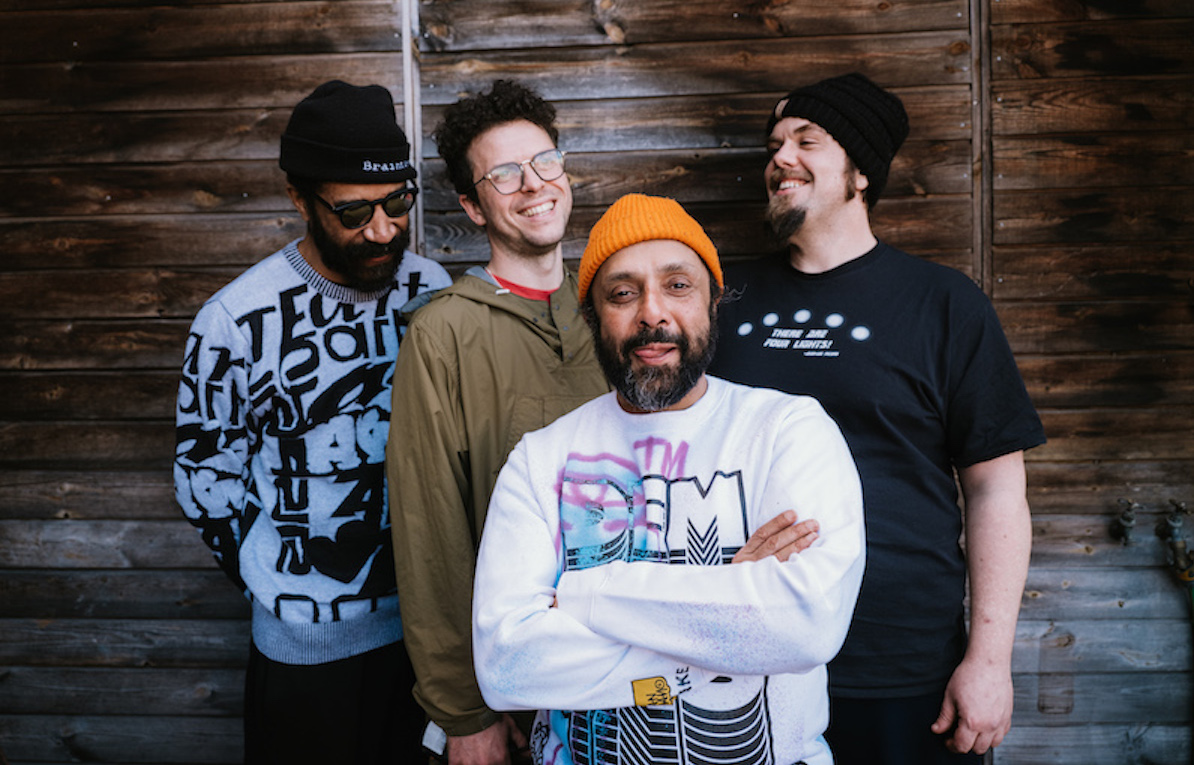
Born as a resident band in an open mic evening in Brixton, that of the Speakers Corner Quartet is a fifteen-year story, which has cultivated dreams and useful stories of meetings in south London now (and finally) to write a real album, the debut one . The quartet, made up of Biscuit on flute, Giles Kwakeulati King-Ashong (known as Kwake Bass) on drums and percussion, Raven Bush on violin and Peter Bennie on bass, has recently released Further out than the edge, their first album, an elegant and reflective work, built around a narration that seems to transport to the heart of a long choral show with many hands and capable of bringing together a long list of friendships and acquaintances that have happened over the years, most of them which are now among the hottest names in pop music yet – in some mod- underground and interesting. Tirzah (partner in the life of Kwake Bass), Kae Tempest, Mica Levi, Coby Sey, Kelsey Lu, Sampha, among the many guests present, thus give their contribution to a choral work that is difficult to fit into a single container, where the electronic jazz mixes with more old school scores and ambient carpets are accompanied by whispered voices and ethereal melodies. A record that comes after more than a decade of nights of spoken word, jazz and hip-hop jam in small venues and that finally brings the sound of the Speakers Corner Quartet to the ears of a wider audience.
“We met at one of the biggest open mic nights in the UK,” says Biscuit, “essentially big hip-hop festivals in central London – that’s where I met Kwake.” A journey that thus begins between endless studio sessions and improvised live shows in small venues in the English capital: «We started seeing him in the studio practically immediately, also because the nights at the Brixton Jamm ended early. Before long we started writing music and playing around; we felt the need to continue with that magic. And so shortly after Peter was added on bass». For Raven Bush to take the violin, however, we will have to wait until 2012, thanks to the internet and one of the most active online communities of those years, Myspace.
The inspiration for the band’s name is to be associated with the famous Speaker’s Corner in Hyde Park in London (a historic place of debate and public speaking which also hosted Karl Marx and George Orwell), to which their idea of music made up of the community, community and openness openly redoes. And it is in the music itself that the four ensure that the essence and values at the origins of the Speaker’s Corner are revived, as in the choice of lyricism of the poetess and musician Kae Tempest who in Geronimo Blues questions the values of society and human relations both with ourselves and with technology, quoting the cry of American paratroopers in World War II who jumped from planes shouting “geronimo” to the wind: «It was the first track to see the light», says Raven, «At the time I was working with Kwake on the soundtrack of Brand New Ancients by Kae, a spoken-word style play. Just as the inspiration for that song originates from an exchange and mutual inspiration, each of the tracks was written and designed with an artist already in mind, or specially sewn so that the artist involved could best dress that dress». adds.
Their first (and until recently only) record release actually dates back to 2009, with the EP Further Back Than The Beginning, but despite appearing distant from the production and recording world, the quartet has always been active behind the scenes and with different roles in the projects of some of the artists involved in their album: «Although we haven’t concretely written an album together before today, we are been among dozens of projects by the people who now appear in ours, from production to live shows. And we continued our own by releasing solo albums. What brought us together as a band was to draw inspiration from each other during the more normal occasions, like preparing a dinner and all being together. Once we decided to do it for real it was completely natural: away from the instruments we have always cultivated ideas and cues for the music that would be born». A spirit that has remained practically unchanged since the beginning: «We started writing a large part of the album already ten years ago, most of the collaborations that appear on the album are people who revolved around the same environment and with whom we have been working for some time».
From the fateful jams to the writing of such a rich and complex album, the world of the Speakers Corner Quartet has changed a lot: «For us, producing the album and taking it on tour are practically two different jobs, certainly. A large part of our language is also based on a great freedom to make sampling and improvisation dialogue, and it is proving interesting to contextualize the work done in the studio differently, giving it a live nature», they explain. «Some songs like Can We Do This? (with Sampha) e Karainagar (with Mica Levi) almost follow the opposite path: being the result of jams in the studio, the same atmosphere as the first take somehow relives during live performances».
Wanting to directly take the album title as a final clue, Further out than the edge translatable into Italian as “farther than the border”, can in some way represent the continuation of the journey beyond the dimension experienced so far. In fact, the tour will see them pass from important stages such as those of Glastonbury and the Montreaux Jazz Festival. “After the record the show is starting to go to incredibly bigger places than what we’re used to. But we want to keep the authenticity behind our ideas,” says Raven. «We recently did a live at Gillett Square in Dalston, a much more intimate set and which was very close to the size we started from. Small venues always have a more particular energy, which needs to be preserved».
The story of the Speakers Corner Quartet, four London musicians brought together by a true passion for playing together, is fascinating precisely because it starts from the roots of sound and the desire to collectively hold the instruments and give each other time so that the magic can happen. It is therefore natural to ask: does the advent of AI in music risk putting all of this at risk? «We are entering a phase in which we will have to consider it a certainty: artificial intelligence will become the competition. But you don’t need to be afraid, we are ready to experiment and understand what it will be able to bring» the band replies confidently. “We’re pretty sure of one thing though: the sensation of hearing a real voice sing live will remain difficult to replicate. As close as digital gets to perfection, music will still belong to people.”