
James Gray is a grandmaster of conversational tangents. Should you meet up with the veteran filmmaker behind Little Odessa, Ad Astra, Armageddon Time, and a number of other movies that run the gamut from epic to scrappy for, say, an old-fashioned coffee klatch, you’ll find yourself wonderfully dizzy from all the detours. If your goal is to interview Gray about a film, however, we wish you the best of luck in staying on topic.
We have no sooner sat down in the back of the Carlton Hotel in Cannes to talk about Paper Tiger, his latest tale of crime and the city that had premiered at the film festival a few days prior, before an off-handed remark about a vintage jacket leads us deep into the weeds. A partial inventory of subjects passionately discussed would include: the dodgy origin story of Hollywood, Ed Sullivan, Raging Bull, YouTube, David Lynch (complete with an absolutely dead-on impersonation of the late filmmaker; Gray is great mimic), Jaco Pastorius, that time Casablanca director Michael Curtiz allegedly killed several people on a film set, the existential pain of a bad cup of coffee, the Beatles’ early demos for Decca Records, and why Ringo Starr is still vastly underrated as a drummer (“They’re not called the Guitar-als, they’re not called the Bass-als, they’re called the fucking Beatles!”).
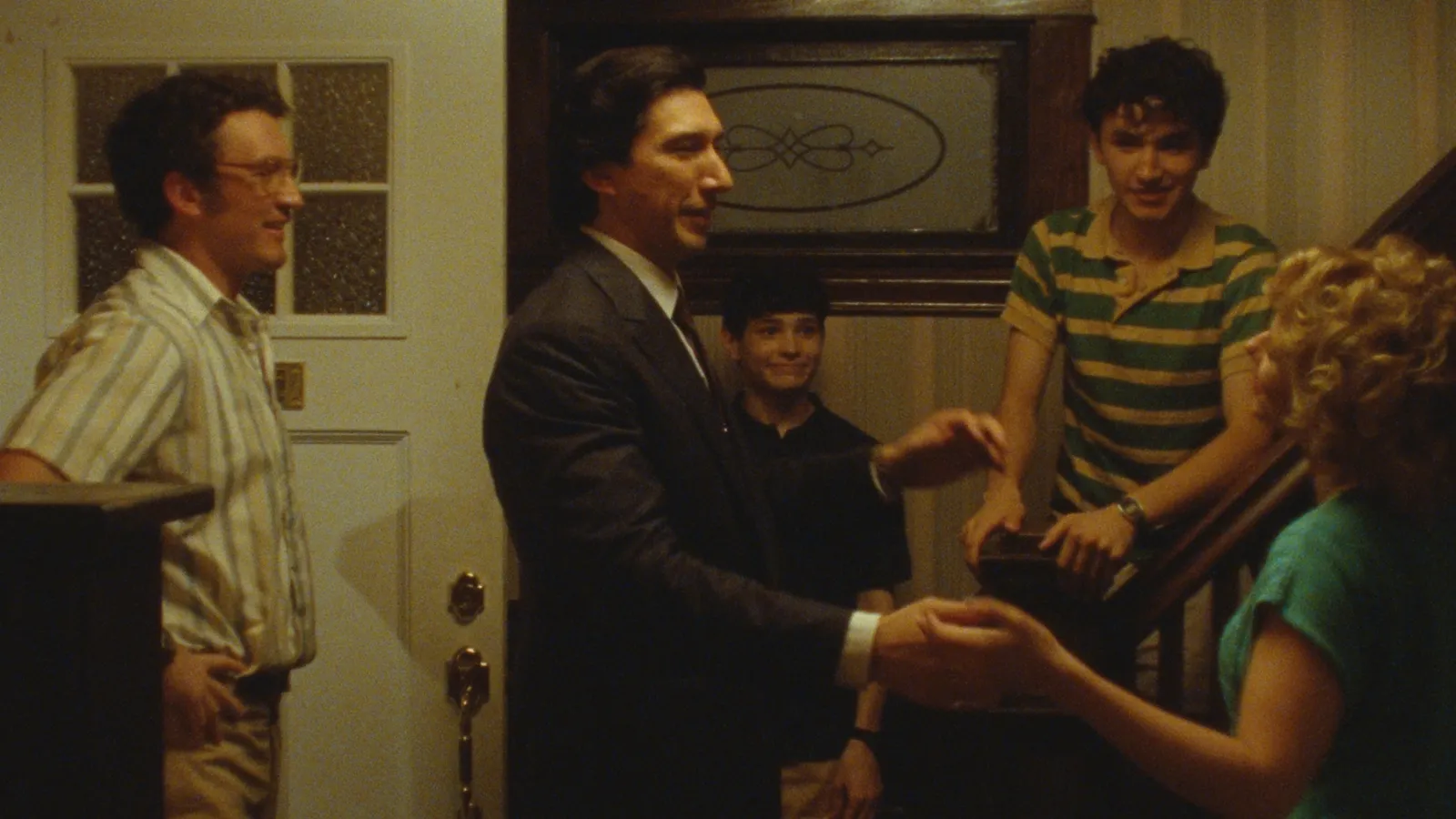
By the time the publicist reappears to make the universal symbol for “wrap it up,” we have only begun to wind our way around to the movie itself, which stars Miles Teller and Adam Driver as brothers living in outer-borough New York circa 1986. Teller plays Irwin Pearl, an engineer with a loving wife, Linda (Scarlett Johansson); two teenage sons, Scott (Gavin Goudey) and Benjamin (Roman Engel); and a comfortable middle-class life. This is the go-go Reagan era, however, and “comfortable” is not enough. The house could be nicer, the car could run better, the upcoming college tuition could be easier to pay off without draining their bank accounts. Irwin had aspirations for something bigger, and more grand. He wants his kids to be proud of him. The guy just needs the opportunity to grab that ever-elusive brass ring.
Enter Gary Pearl (Driver), an ex-cop who’d used his connections to make money moves and has done extremely well for himself: a BMW, flashy Italian suits, getting Peter Luger’s Steakhouse to cater a weeknight dinner for his extended relatives at home. Gary wants to cut his brother in on what could be a lucrative deal, involving Russian immigrants setting up shop near the Gowanus Canal. The Brooklyn waterway is in desperate need of passing pollution standards, and Gary thinks he and Irwin can make a fortune as “consultants” for these new business owners. The only potential issue regarding this master plan is the Russian mob. That turns out to be quite a big issue.
With its emphasis on family, corruption, the criminal underworld, and the American Success Story, Paper Tiger finds Gray returning to the sort of rough-edged, throwback style that first established him as an American filmmaker with a keen sense of regional grit. And like Armageddon Time, his 2022 coming-of-age drama set in early Eighties Queens, there is, by Gray’s own admission, a lot of autobiographical elements. The reception at Cannes has been close to rapturous, and it has a good chance of winning Gray his first Palme d’Or. Regardless of whether it leaves the fest empty-handed or not, it’s a victory for the filmmaker. (Neon is set to release the movie in the fall.)
After setting up a follow-up interview, Gray jumps on a Zoom the next day while on a boat (long story) and continues talking candidly about the genesis of Paper Tiger, its connection to his previous film, his decision to return to a more intimate type of storytelling, and a lot more. This interview is drawn from both conversations and has been edited for clarity, length, and a minimal amount of references to Ringo Starr.
So, you mentioned the press conference that part of this comes from a trip to the Soviet Union in 1984…
Yeah, my memory of that trip is very clear. I was there as a student — and the country was broken. Nothing functioned, and the country had started to sort of realize it’s in a state of sclerosis. So that’s when glasnost, perestroika, the introduction of market reforms comes to Russia, and the cracks in the socialist dictatorship begin to sort of come apart.
So what I was trying to do with the film was essentially to say that: It all starts there. That’s the beginning of the moment that the market becomes God, in which case all of those moral and ethical components to our behavior become null and void. Everything becomes transactional. There is no idea of good or bad. There is no idea if we’re on the correct side. We’re the good guys. It’s all: what can you do for me? Because this is naked corruption, naked market forces just saying, “I’m going to make the most money possible.”
How did that bigger, more seismic shift in geopolitical history lead to a story of family in Queens?
I had long tried to find an idea for a story about where we are today, which is the unquestioned supremacy of market economics over everything — what is the cost? What’s the price we pay for that? And you know that quote from the Greeks that opens the movie, maybe it’s too much. But it seems so perfect to me: “Let there be wealth without tears, enough for the wise man who knows no further.” In other words, the quest for wealth for its own sake is a meaningless and bankrupt end. If it’s unmoored from who we are in the spiritual side and the soul, we’re going to be very adrift.
The idea of the movie was, what happens when you take a nuclear family, and with a slight bit of ambition but a whole lot of love inside that unit — what happens when that family is really introduced to the marketplace? And to the dreams of trying to become a rich person that are unmoored from ethical and moral consideration? It’s the thing that tears it apart.
These notions started to play around in my head. How can I express that in a story? And I used, of course, my own experiences as a teenager, coupled with really the most formative thing that I went through, which is that my father… . [Long pause]
My father and mother, and my brother and I, we were all very screwed up. Of course, every family is screwed up, right? Tolstoy told us that a long time ago. But we still had a ton of love, and within a span of two months, I went off to USC film school, 3000 miles away from New York. My brother had become his own man. My mother died of brain cancer, and my father began to have legal troubles, which wound up with him facing prison time. So that family unit that I knew — that meant everything to me — was completely broken apart. My father’s troubles were entirely due to his ambitions to make a ton of money. He had everything he wanted, he had everything he needed, he had a wife and children. It was all going okay, and within a two month period, it ended. I’ve been grappling with that loss ever since. I can see it now, even with my own children.
Your previous movie, Armageddon Time, was explicitly autobiographical. It’s basically a meory piece.
It is, yeah.
How autobiographical is Paper Tiger? Given whet you just said about your family, they sound remarkably similar to the Pearls…
I mean, in the case of something like Armageddon Time, that’s 98-percent factually autobiographical. With this, it’s about 90-percent. So, not an autobiography, but yeah. It’s very close.
Is Adam Driver’s character — the uncle who’s flashy and cocky and a mover and shaker — based on a real-life figure as well?
The uncle is not an invention, it’s actually… he’s a composite of two people. There’s my uncle, who’s long dead now, and one of my father’s business partners. But they were very similar in a way too, so I combined them both. They’re a composite, because you know, with a movie, it’s not like a mini series. You have to condense things.
But the whole reason for that is not to just recount the facts of your life. The point of that is to say: What is the shortcut to trying to put as much of yourself in there as possible without being obvious? You know, one of the great things I remember is that when my brother and I were young — I think I would have been 11, and my brother was 13. We went to the Sutton Theater on 57th Street, which is long gone, and we saw Raging Bull, and I remember… this is a horrible admission.
It’s a safe space, James. Go on.
I remember that we laughed so much in the movie. Listen, we really loved it, but we thought it was like our neighborhood, where the guy would throw open the window and go, [in Robert De Niro voice] “Hey, Larry, you gonna find that dog dead in the hallway, Larry!” We were laughing, because it was the first time we saw a movie in the theater where it was like people from our neighborhood, and we could recognize the honesty of it. You’re always trying to get that level of versimilitude into your movies. So the whole idea is, I stole all that stuff from my own experience.

Miles Teller, James Gray and Adam Driver during the “Paper Tiger” photo call at the 79th annual Cannes Film Festival.
Stephane Cardinale/Corbis/Getty Images
How did you end up casting your three leads?
So do you know the Criterion Channel?
[Laughs] Yes, James, I know the Criterion Channel.
Of course you do. So they was generous enough to show a number of my movies as part of a series, and I guess Adam Driver, who is also addicted to the Criterion Channel like you, he saw them. I mean, I think he’d seen a couple of the others already, but Adam saw all of them in one go. Then he reached out to me and said, you know, why don’t we do something? I think he’s a great actor, so I wrote that part for him.
And then with the other two characters, the original basis for it was in discussions, actually with Annie Hathaway and Jeremy Strong as a kind of… I don’t want to say it was designed as a sequel to Armageddon Time, because I was always going to make it in a slightly different style. But for lack of a better word, let’s say “sequel.”
Yeah, I wanted to ask you about that. There were rumors that they were going to kinda sorta reprise those roles…
Right. Then Then Annie said to me, she said, “Well, I’m doing Chris Nolan’s The Odyssey.” So I asked Chris, I said, ‘Well, how long are you shooting for?” he told me, “Seven months.” I said, “Well, that’s not going to work out for anybody!” And Jeremy was doing this Aaron Sorkin movie, which I think is the Social Network sequel, right? “Ok, when you finish with that, maybe we can do it then? “Well, then after that, I do a mini series…” Which, by the way, he’s still shooting! That thing is going on forever.
So I said, Ok, well, shit — that means neither of them are going to be available. So then I thought, well, who do I want to work with? Who is a woman from New York, who is Jewish, who would authentically understand this world? And then I thought to myself, “Who’s like the biggest female star in the world right now? It’s a Jewish woman from New York!” So I wrote Scarlett a letter. I had met her once before on another project, which didn’t come to pass. And I said, would you ever consider this? And she read it very quickly and said, “I would love to be a part of this.”
With Irwin… I had real trouble because I didn’t write it with any actor in mind, really, because the Jeremy Strong thing was resolved pretty quickly before I was still in outline stage. So when I started writing it, I had only my father in mind, who was a very, in some ways, a bookish guy, but also had a very blue collar, bruising quality to him — almost like a young James Caan. And thought, Well, who the hell is that actor? I couldn’t think of anybody who was Jewish from, you know, New York, or close to there.
Then late one night, this movie Bleed for This came on, and I thought, well, that Miles Teller guy is fantastic, but he’s too young. So I had a conversation with his agent. She said, “No, no, he’s not too young. What are you talking about? Have a meeting with him!”
I was so pleasantly surprised by his charm, and he’s very playful — he likes to talk about, like, his Ford Bronco and stuff. He’s not pretentious at all, and I knew that Adam really liked him, so they would have that brotherly rapport. Adam and he really love each other, and Scarlett just loved the idea. He’s also Jewish, you know, and from New Jersey, so I thought, well, this is going to work.
There’s a great sequence near the end where Adam’s character is hiding in this field of tall grass from these thugs — how’d you conceive of that?
Part of it comes from real life. When I was a kid, there was a park in near Howard Beach, and my brother and I got lost in the tall grass over there. That kind of grass, by the way, is called Phragmites grass. It’s the tall weeds. So many people have said to me, “Oh, that scene in the corn” — but as you well know, there’s no corn really in New York. It’s just these massive weeds on this wet marshland. And I got lost, and it’s something that freaks me out to this day, you know. I still have bad dreams about it, because you immediately lose any sense of direction. But it’s a great place for a shootout.
And the other part?
I had seen a fantastic movie called Samurai Rebellion with Toshira Mifune, which has this amazing ending in these very tall weeds, and these people are shooting at Mifune. You don’t see them, but you hear the gunshots. What if I did the opposite? You know, where you don’t hear the gunshots because of the environment or whatever? I was just looking for something that had a kind of cosmic importance that the character was going to return to the primordial ooze, and that it would be not urban in feel at all.
Before you made Armageddon Time, you were coming off this string of films that were big, and incredibly ambitious in terms of scope: The Immigrant, Lost City of Z, Ad Astra. People mentioned that Armageddon felt more like…
More like the classical, more back-to-basics stuff I did early on, yeah.
Right. And with Paper Tiger, you seem to be scaling things down even further and done something that resembles your first two movies [Little Odessa and The Yards]. Was there a conscious decision on you part to go back to what you call “the back-to-basics” stuff?
I suppose some of it there was a tiny bit of a conscious decision, insofar as I wanted to not let the machinery of a new kind of plot or style get in the way of what it is I really wanted to try to get at. Which was something emotionally direct and something sincere, and trying to strip away all of the kind of the reliance on… . [Pause]
I mean, look, I’m very proud, for example, of Lost City of Z. I have no regrets making it. It was an incredible experience, and I’m very fond of the film for a variety of reasons. But when you go to the jungle, it’s an unbelievably difficult thing. You find yourself conquering not just aspects of storytelling, or character, or performance, but you’re also having to tackle like the physical punishment every day, and to try and make sure the story works in the context of this thing. This time, I wanted to be like, “Ok, let me give myself a box to play in. Let me try to focus on as honest an expression of love as I can. Let me focus on the best performance for the actors that I can.” I hate to say it, but it just came down to a very practical decision, actually, to try and avoid the traps of very elaborate plots, because you don’t need that. I mean, do you remember what the plot of Raging Bull is?
Kind of?
Raging Bull is a masterpiece. Raging Bull does not have a great plot. What you remember what the emotional impact of the thing was on you. I was going for something closer to that. [Pause] I think, to answer your question more honestly, I must have felt on some level, go back to what you know, and then try to go deeper.
I’d read a recent interview with you where you were quoted as saying that you went into Paper Tiger with a central question in mind, which was, “How do you make a movie where the whole point of it is the expression of love?”
Did I say that? That’s really good. [Laughs]
It is good. So how do you do that?
Often in life, love is represented by the best of intentions, but the best of intentions are often totally awful. Linda wants to save her husband by not telling him she’s sick. Irwin doesn’t tell her about the Russian Mob thing, so she doesn’t worry. Gary, he probably knows or suspects a little more about some nefariousness down there by the canal. He’s street-smart. But he wants his brother to be successful like he is. It’s like everybody’s not telling somebody something to protect them or help them.
And why does Irwin get involved with this scheme in the first place? He wants to be a man in the eyes of his sons. When his sons say, “Why do we have to drive a crappy car?” — that’s why he wants to prove to them that he’s a man. All of these things, these screw-ups are actually expressions of saying, I love you, and I want you to love me. That longing is the most human desire.
To be honest: It’s impressive that you manage to keep making personal, character-driven movies like this, with these types of casts, in this day and age.
I wish I couldn’t say that it isn’t hard to make these kinds of movies now, but it is. I mean, I had 31 executive producers. It’s almost impossible. My own feeling is this: if I had wanted to enter the movie business just to make like a ton of money or be famous, certainly a ton of money, I would have gone probably into investment banking. If I’d wanted to be famous — I have zero interest in that, except if it helps me get a nice table at a restaurant. But as you mature, you realize that chasing fame is a folly.
So, what’s left? What’s left is a kind of different version of what I was just trying to express to you, is that you say, okay, what can I do as a person who is trying to be a moral and ethical actor on the planet to contribute to this mountain of endeavor that we call progress? What can I do to add to that, and the truth is, you add your voice. So I have just fought to make sure that that’s the case, and it does involve some sacrifices, obviously. But those are very small prices to pay for what I think is the most beautiful endeavor we can try to undertake.
What’s that?
Self-expression. That’s the coin of the realm.