
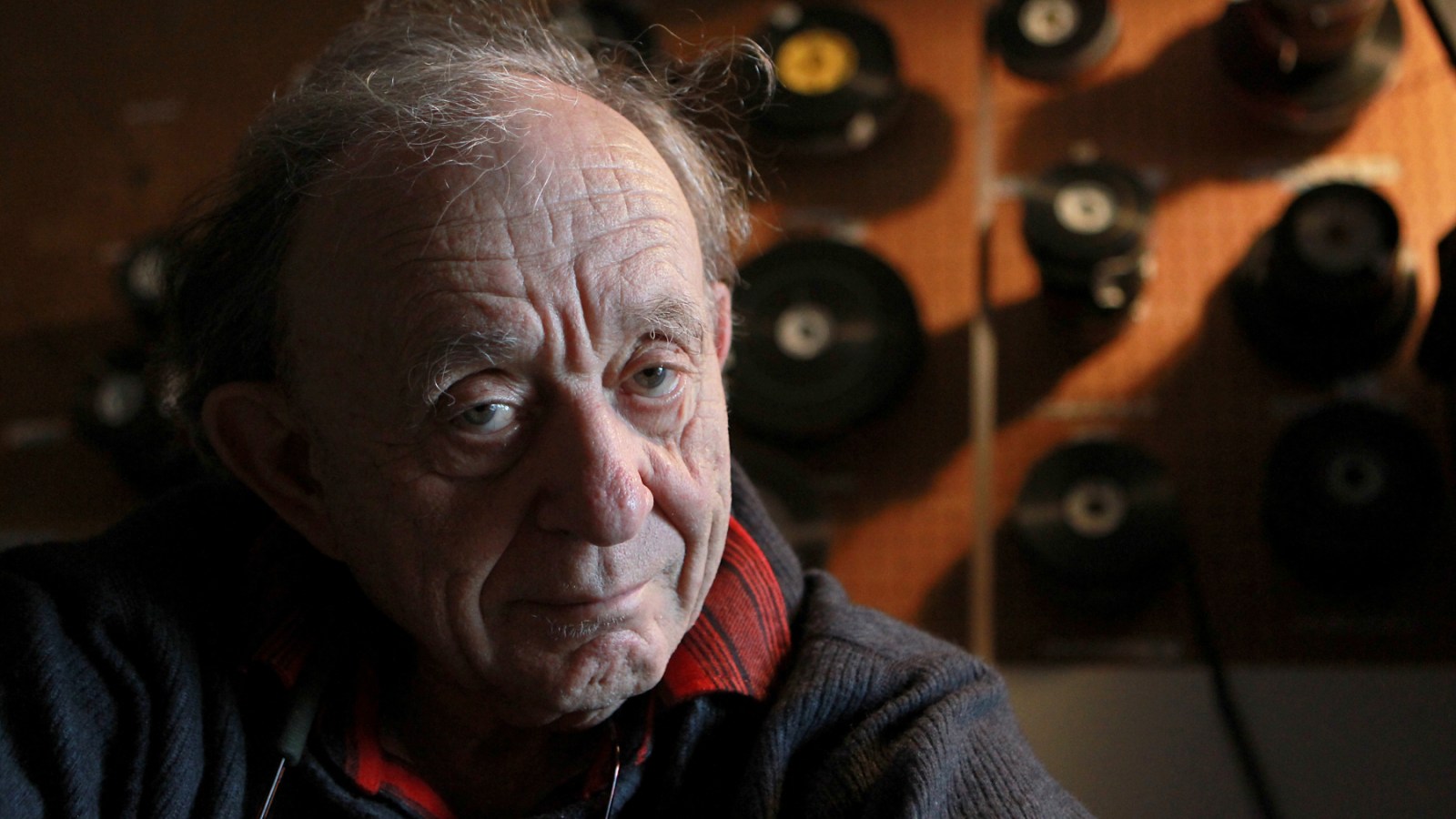
Frederick Wiseman, a titan of American cinema whose singular approach to observational documentaries inspired generations of younger filmmakers, died on Monday. He was 96. Wiseman’s family confirmed the filmmaker’s death through his distribution company Zipporah Films.
Starting with his first film, 1967’s Titicut Follies, the director mastered a specific approach to nonfiction, eschewing talking-head interviews, explanatory title cards, and scores in favor of immersing viewers in unique worlds that played out in front of his camera. Wiseman was fascinated with how systems work — whether they be mental institutions, city halls, museums, boxing gyms, ballet companies, high schools, slaughterhouses, cabarets, or Madison Square Garden. And by making himself invisible in these environments, he captured the everyday with a minimum of fuss, letting the minutiae of life unfold without artifice. The result were movies that felt all-encompassing while eluding easy categorization.
“I genuinely feel if I could summarize the movie in 25 words or less, I shouldn’t make the movie,” he said in 2018.
Born on New Year’s Day 1930, Wiseman grew up in Massachusetts, earning a law degree at Yale before being drafted in the Army in 1954. In the fall of 1956, his tour was over, and he headed to Paris for two years. It was there that he first tried his hand at filmmaking. “I shot a lot of films in 8mm,” he recalled in 2016. “But I was just fooling around — filming my wife shopping, or market streets, the ordinary thing that everybody does when they’re fooling around with their first movie camera. … Nothing ever saw the light of day. I haven’t looked at it for years — I don’t even know where it is. It was never edited or anything. We looked at it for amusement’s sake and that was it.”
When Wiseman returned to the states, he taught law in Boston. He hated the job, but as part of a class on criminal law, he took his students to Bridgewater State Hospital, observing how poorly the mentally unwell inmates were treated. Gaining permission to film inside the hospital, he spent roughly a month shooting the prisoners and staff, depicting the hellish conditions — including forced nudity and demeaning talent shows — with a calm, clear-eyed detachment that made the footage even more damning. Wiseman would fight legal battles that tried to suppress Titicut Follies because of the raw truth it exposed, but the film remains one of the most shocking portraits of prison life. It also established the stripped-down approach Wiseman would pursue for the next nearly 60 years.
“I liked working in this style,” he explained in a 2016 profile. “It seemed to me an appropriate style to use when I was trying to make films about real situations, where I wasn’t asking people to do anything especially for me. And using a hand-held tape recorder, and a hand-held camera, and no artificial light, lends itself to that. The idea always has been to capture as many different aspects of what’s going on in the world as I can on film.”
For the rest of his life, Wiseman would make a new documentary on a near-annual basis, their barebones titles reflecting their subject matter: High School, Law and Order, Hospital, Basic Training. Regularly avoiding a central figure, his movies sought to understand the inner workings of the places where he filmed. “I had seen so many films that followed one charming individual, whether it were a movie star or rock star, that I thought it would be more interesting to make a film in which the place were the star,” he once said. “Essentially, what I have been doing since then is a form of natural history. I try to look at what is going on to discover what kind of power relationships exist and differences between ideology and the practice in terms of the way people are treated. The theme that unites the films is the relationship of people to authority.”
He entered each new space with no preconceived notions, aiming his camera at something that piqued his interest and waiting to see what developed. His films rarely had tidy narratives — another example of the conventions of documentaries that he disliked — and, instead, conjured up a sense of what it was like to, say, spend time in Central Park or at London’s National Gallery, whether as a patron or as an employee. But he objected to his movies being described as cinéma vérité, saying in a 2014 interview, “I think it’s a pretentious French term. What I try to do is edit the films so that they will have a dramatic structure, and for me the term cinéma vérité or at least observational cinema connotes just hanging around with one thing being as valuable as another and that is not true. At least that is not true for me.”
Indeed, his movies were tightly controlled in the editing process, with Wiseman putting together the films himself. They often spanned three or more hours, the director giving himself one rule in terms of what to keep and what to cut: Could he justify why that particular scene had to stay in? If he couldn’t, then out it went. And he resisted explaining his films after he made them, although he was quick to contradict audiences’ assumptions about his intentions. His 2018 documentary Monrovia, Indiana, about a small town in a red state, was widely viewed as a look at “Trump’s America.” Wiseman argued that he had no such agenda.
“I didn’t want to assume that just because I was making a movie about a small town — where 95 percent of the population was white — that it was necessarily a movie about ‘Trump’s America,’ because I don’t know what that means, actually,” he told Mel magazine in 2018. “I was interested in daily life in an all-white town in the Middle West. I didn’t even know that I was gonna discover any direct expression of an attitude toward Trump. It was all political conversation about what was going on in Monrovia. … The town voted 65 percent for Trump. But what constitutes ‘Trump’s world’? I don’t think [that] has a simple answer.”
That refusal to go for the easy answer in his documentaries — while at the same time carefully shaping the material to say something larger about how an ecosystem works — made Wiseman’s movies essential templates for ways of thinking about local governments, universities, and art institutes. No filmmaker ever rendered board meetings and town halls more rivetingly. Simply listening to the exchange of ideas and differing points of view in his movies resulted in electric sequences. And in documentaries such as Ex Libris: The New York Public Library and At Berkeley, Wiseman quietly celebrated the pursuit of knowledge while not shying away from the financial and logistical challenges such places endure.
His curiosity was inexhaustible, finding as much engrossing about adolescence (High School) as old age (Near Death). And although Wiseman’s movies never enjoyed mainstream attention, their impact has been felt everywhere — and not just among other documentarians. When Japanese writer-director Ryusuke Hamaguchi included an engrossing town-hall meeting in his 2023 thriller Evil Does Not Exist, he cited Wiseman as his inspiration for the sequence, naming him as one of his favorite filmmakers. Wiseman turned his 1975 documentary Welfare into an opera, and Titicut Follies was adapted into a ballet. And he would occasionally provide a cameo in other directors’ films — most recently being a voice on the radio in the indie baseball drama Eephus and playing a therapist in the French drama A Private Life.
Near the end of his life, Wiseman made some of his finest works. His last documentary, 2023’s Menus-Plaisirs – Les Troisgros, was an epic peek inside three acclaimed French restaurants run by the Troisgros family. It won Best Documentary from the New York Film Critics Circle, the Los Angeles Film Critics Association, and the National Society of Film Critics. Wiseman never received an Academy Award nomination across his storied career, but he was awarded an Honorary Oscar in 2017 that acknowledged his “masterful and distinctive documentaries [which] examine the familiar and reveal the unexpected.”
In recent times, he enjoyed extensive retrospectives of his work in New York and Los Angeles, and he remained a regular fixture at the world’s most prestigious film festivals. But he never rested on his laurels, always happily engaging with his latest project and hungry to learn more.
“I don’t know what I’d do with myself if I didn’t work,” he said in 2018. “I’m not exactly a youngster, although I think I am. Working is very important to me. I think I’m working harder now than I did 25 years ago, because it keeps my mind off the Grim Reaper. The best thing I can do for myself at my age is to be completely absorbed in my work. And I’m lucky: My health is okay, and I can still do it. I have no idea how long it will last.
“I didn’t make my first movie until I was 36 — I drifted around not doing anything I particularly liked, and I wasn’t very happy doing what I was doing,” he added. “Since [Titicut], I’ve been acting like I was shot from a gun because I found something I liked. It’s not work for me — it’s a passion. I have the same enthusiasm about doing it as I did 50 years ago.”
Daniel D`Amico for SANREMO.FM