
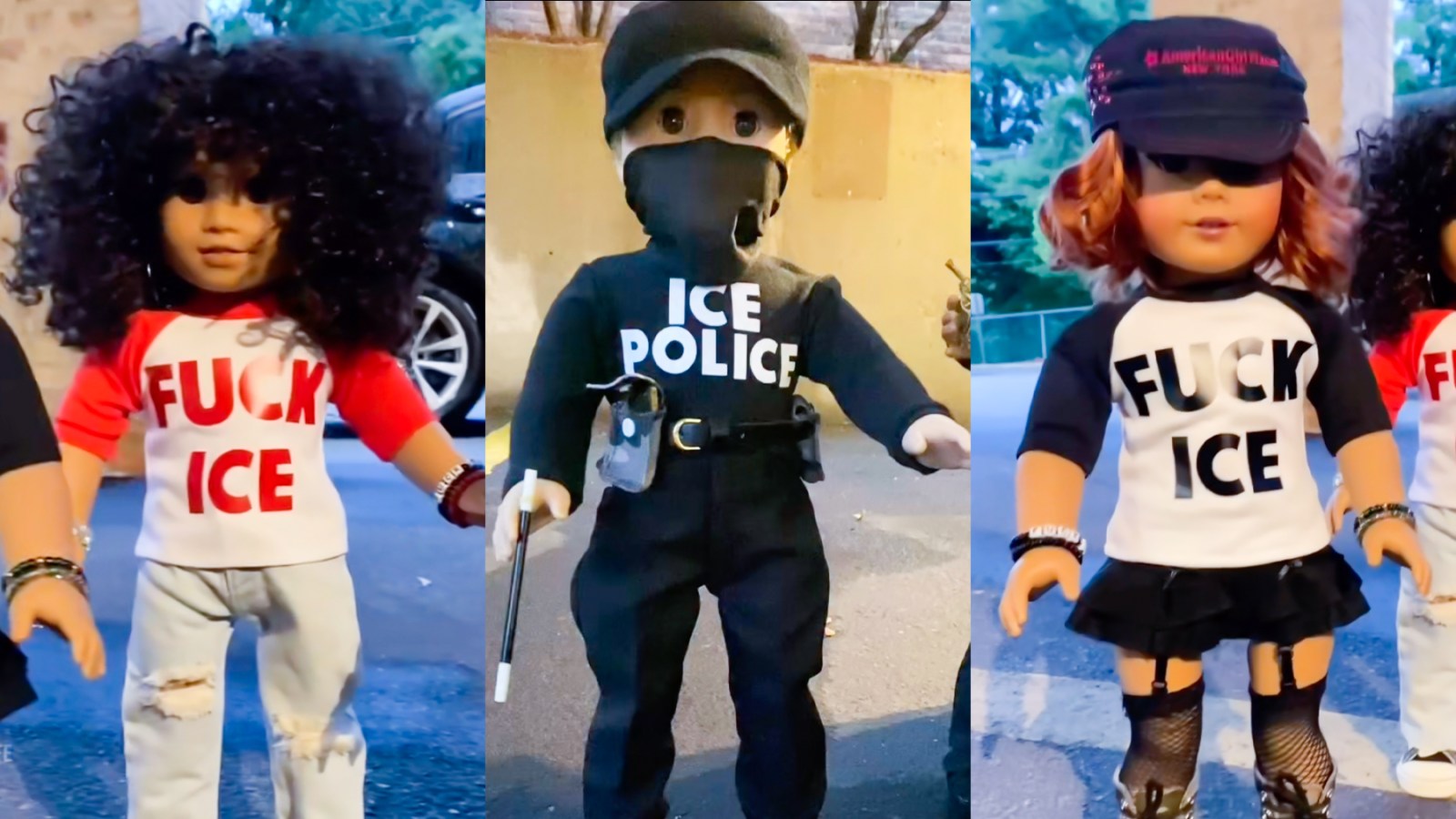
A few weeks ago, my Instagram algorithm decided I needed to see a post about how American Girl dolls handled their divorces. Intrigued, I briefly scanned the post, Molly told her spouse “I survived a war. I'm not afraid of starting over.” I was a bit confused as to why Instagram decided I needed to see this content, but I am an elder millennial whose prized possession was this doll when I was 10 — shoutout to Samantha! — so I simply chuckled and moved on. Then, more American Girl doll content started flooding my feed, both on Instagram and TikTok. This time, though, rather than divorcing their husbands, several of the dolls were protesting ICE.
“Kirsten will be happy when ICE gets the f*ck out of Minnesota,” read one post, over a photo of the blonde-haired, blue-eyed American Girl doll standing outside in the snow. (The post has more than 42,000 likes on Instagram.)
Consider me hooked.
First, let's back up. The historical American Girl dolls and accompanying books were all the rage for (slightly nerdy) girls in the 1990s. Each of the original three girls, launched in 1986, came from a different period in US history — like Kirsten, a Swedish immigrant living in 1850s Minnesota; Samantha the wealthy orphan from turn-of-the-20th-Century New York; and the bespectacled Molly, who lives in Illinois in the late World War II era. Addy, a freed enslaved girl living in 1860s Philadelphia, was the first Black doll, released eight years later. (There are now more than a dozen dolls in the historical collection.) And while they had their challenges — the historical accounts were pretty thoroughly white-washed, and the dolls and accessories hit at a price point that made them unattainable for many families — the characters fought out against injustices.

Instagram/backintimeag
As millennials who owned the dolls have grown up and had children, and nostalgia has driven clicks on social media, an entire American Girl subculture has developed. Influencers started visiting the American Girl Doll Cafe, dubbing it “Disneyland for literary girls and gays,” Saturday Night Live dedicated a sketch to the dolls trauma-bonding over tea in 2022. During the 2024 election, some doll-fluencers used their accounts to share political news and speak out against the return of President Donald Trump.
To some, it may seem odd to see these 18-inch dolls being used to make political statements, but for those who are deep in the American Girl world, it's only natural. Caitlyn Cordova, the person behind Instagram account @backintimeag, created the viral anti-ICE Kirsten meme at the end of January. She says she was surprised to see comments on the post saying things like, “You know it's bad when the American Girl community is radicalized.”
“We've been radicalized since the Nineties!” she exclaims in an interview with Rolling Stone. “And if you're not, you're not experiencing the historical side of American Girl and what they teach.”
Cordova was a childhood collector of the dolls in the 1990s and 2000s and says she brought them back out of storage when her eldest daughter was about seven years old. Cordova lives in New Jersey and has two daughters, now 10 and five, and says she enjoys reading the books with them to learn history and show how these characters stood up for others. She's a photographer and also sews historical dresses for the dolls, setting up scenes and taking pictures for her social media account. She said at the end of January, while watching ICE take over Minnesota, it made her think of Kirsten.
“It clicked in my head, I knew that if she was real and in some weird time warp, she would be against ICE,” says Cordova. “The girls would not be tolerating what is happening in this country.” (Mattel, which owns American Girl, did not respond to an interview request.)
Cordova brought her Kirsten doll outside in the snow and took some photos, adding text onto the post and publishing it. One of her followers posted it on BlueSky, where it took off. Since then, Cordova says, her followers have been asking her to make more anti-ICE content for different cities, but she only wants to do it for things that feel appropriate to the character. She recently posted another meme with Josefina, a character from the 1820s who lived in what would become New Mexico. Josefina's text reads, “ICE needs to get the f*ck out of my country.”
Cordova is not alone in posting anti-ICE content. Well-known American Girl doll influencer @hellicity_merriman has posted political doll content for years, including recently a post of a doll holding a toy gun alongside the text “Fuck ICE.” (@helicity_merriman did not respond to Rolling Stone's request for comment.) Another doll collector, username @agtv4life, likes to dress up the various American Girl dolls she has and stage them in different protest scenes.
Jo, as she asked to be called for anonymity reasons, is 60 years old and lives outside of New York City. As someone who has worked in management in the financial sector for more than 30 years, she started using the dolls as a way to express her creative side.
“I came from poverty and food stamps and barely had any toys,” says Jo, a single mom who started collecting the dolls for her youngest daughter. She now has more than 100 dolls.
For a long time, Jo's content focused on styling the dolls' outfits and curating dollhouse scenes, throwing a birthday party for Molly or offering three different sunglass options for Sophie. But when President Donald Trump ran for re-election, Jo decided to make her content more political. “With all of the despair that I was feeling, along with a lot of other people, I decided that I would voice how I felt through the dolls,” says Jo, who runs both a YouTube channel and Instagram account.On June 13, 2025, she dressed her dolls in anti-Trump clothing she had made and then staged them in a No Kings Day protest.
“I did the doll protest before I went into New York City and did my [in-person] protest,” Jo says. She's also done a post where the dolls demand the release of the Epstein files, and in August of last year did an anti-ICE doll protest.
“I've taken a wagon of dolls into New York City, I'll sit them on the seats in the subway,” says Jo. “People look at me like I'm a little bit crazy, but I don't really care. Do what makes you happy.”
Jo has an Etsy shop where she sells doll clothes and protest signs for other people. She's recently started putting together political rally kits that she sends out with the doll t-shirts people buy, and includes stamped postcards for people to write to their representatives.
Jo says since it's been cold in New York lately, she has been staging her videos inside, with dolls doing podcasts, working at campaign headquarters, or phone banking. “They're being like us, or how we're supposed to be,” she says.
“Rather than sitting around and being pissed off and watching the news, before, work, after, work on weekends, I invest time in this,” Jo says. “I'll fill Etsy orders and shirts that say Fuck ICE. I send them out with personalized notes. It makes me happy to know that we're in this together, to connect with people that feel the same way I do and build community. Even if it started with an American Girl doll, I don't care. Some people start other ways. That's how I started.”
