
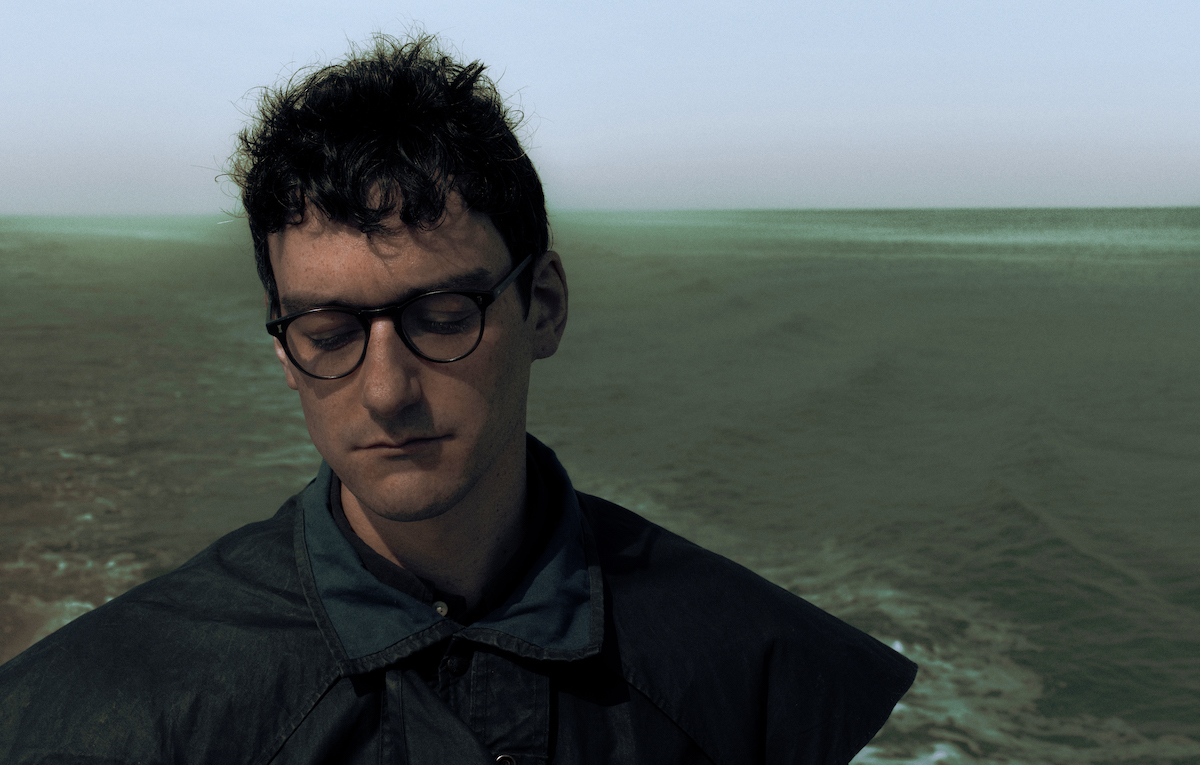
A composer of the sixteenth century, the captain of slow violence, the champions of 90s Europop. Claudio Monteverdi, Gigi D'Agostino, Eiffel 65. Placing them next to each other is really difficult to find a connection; we are talking about worlds – sound and temporal – very distant. Yet for Danny L Harle they not only coexist, but actually form a precise constellation. “It's absurd to put everything together like this, I know,” he says, almost laughing. “But that's what I've always done: connecting seemingly distant things.”
This is where we need to start to understand the sonic idea of English producer Danny L Harle and his new album Ceruleana record that has its roots in classical music and Italian trance, building on a mix of emotional electronics to dance to and contemporary pop to sing. A work in which, as can easily be understood from the names mentioned, there is a lot of Italy: «I have no idea why there is so much Italian influence in this album. But those mentioned were fundamental musicians for me.”
For Danny it's not about quotations or nostalgia, nor even about a joke. Just as when in the past he had recovered and worked on genres considered less than noble such as mákina and happy hardcore; for him music is always a serious matter. «Doing things with humor, with a light heart, doesn't mean not doing them well», he wants to point out. «Even at the beginning of PC Music, AG Cook and I were always very serious about what we did: my music is not ironic».
Since we last spoke – in 2021, for his album Harlecore – Danny's career exploded. In recent years, in fact, as a key figure in the hyperpop universe of PC Music (where his choices, often considered ironic, have now become canon), he contributed to redefining the experimental pop of the 1910s by producing albums such as Desire, I Want To Turn Into You And Choke Enoughthe revelation albums by Caroline Polachek and Oklou.
From Harlecorea plural project that investigated various “minor” musical genres, to date, however, it has not been an all-downhill road. «It's easy now to look back and see a precise path, but in between there were empty journeys, sessions that led nowhere, great projects that foundered». Shipwrecks which, however, helped Harle understand that his idea of becoming a super hit producer couldn't work: «Every time I tried to make music thinking about what others would like, it always went terribly wrong». Simply because, when he dressed as a hitmaker, he lost sight of “a sort of guiding light in my musical life: a vision of how I want music to sound.” But then Dua Lipa arrived.
And Harle thus finds himself co-producing – together with Kevin Parker aka Tame Impala – Radical Optimism by Dua Lipa, one of the most anticipated pop records of 2024. Ambition? Don't get lost in making «easy pop». For someone who had decided to abandon the path of the chart producer, a nice change of heart. Isn't it that – due to profile and money – it's impossible to say no to someone like Dua Lipa? «Look, I said no to many names, even big ones, even artists who were my fans. But you know, if no pieces are taken during the various sessions, you don't make any money. And in life I understood that if I have nothing to contribute to a project, as well as not having a piece that ends up on that type of record, I waste everyone's time. I'm not versatile enough to work with everyone.”
This is how he explains the work with Dua Lipa: «I had a clear idea of what I could offer. In these things there must be a shared interest between artist and producer, a sort of Venn diagram, you know the one where two together intersect creating a common area? Here, with me and Dua Lipa the diagram worked.”
A true friendship developed between the two, so much so that the pop star agreed to participate in Cerulean with Two Heartsa song born during the sessions of Radical Optimism. «No one could sing it other than Dua Lipa, she has a unique vocal range among those I know. If she hadn't wanted to do it, I would have taken her off the record.” And that's the point of the whole album: each song has a specific voice, and that voice must be irreplaceable. «It's important that a song doesn't sound like a hit that anyone could sing. Identity is fundamental.”
The featurings present confirm this logic. From his companion Caroline Polachek, someone who has made the timbre excursion her own brand, to Oklou, one of the most intriguing voices of today's avant-pop. And again, in addition to Dua Lipa, the slightly adolescent urban tone of PinkPantheress, to the bedroom pop tone of a completely different artist like Clairo. «No one could sing those songs like them», he clarifies as a corollary of this line-up.
Cerulean it is also the album in which Harle definitively focuses on his relationship with classical music, currently at the center of a certain renaissance (and not only for Lux of Rosalía). The turning point, for the producer, dates back to Parachuteexcerpt from Pang by Caroline Polachek. «I was playing with chords inspired by Bruckner, sequences that continued to modulate and suspend themselves», he says. “I thought: I like these chords and I love how modern they sound with my equipment.” He says that it was like an epiphany, the moment when «I realized that I could take what I like about classical music and bring it to electronic music. I'm not the first, but I did it my way.”
For this reason he rejects the idea of a “hybridized” classic in a superficial way. “When people think of classical and electronic together, they imagine '70s disco records with Beethoven strings on top of a straight kick,” he says. “For me that is the worst thing of both worlds.”
In Cerulean we find Monteverdi-style chord modulations and Gigi D'Agostino's ultra-emotional synths (with which, he reveals, he would like to do a back-to-back DJ set). The 13 tracks tell Harle's sonic story. They do it so well that Harle himself found himself having to define it as his “debut album”, precisely because of its internal coherence, placing Harlecore in another category of his discography, as if it were a mixtape or a compilation.
After all, Harle is a particular type. He writes dance music to dance to, but he comes from a classical background, he produces pop pieces with Dua Lipa but his idea of listening is not a concert, but with headphones in solitude. “I think I needed distance between myself and the music to really feel my emotional response,” he says. “It's as if the song is something separate singing to me.” Music becomes an object, “almost like a painting or a sculpture”. Cerulean it's as if it were his first solo show in a very cool gallery frequented by the best international artists, rather than critics and tourists.
But don't think that we are talking about an inaccessible producer. As already demonstrated in the past, and reconfirmed in Ceruleanwhat moves Danny L Harle is always something very pure, something that lies between fantasy and reality and that wants to speak to our (and his) inner child. And with a certain innocence that recalls childhood. «I am very tied to childhood in my relationship with music. When I can glimpse that boundary between fantasy and reality again, like in the film FantasyI'm almost moved to tears: that's what I look for in music.”
To explain it better, Harle tells me an anecdote from a trip to Disneyland with his two daughters (who also appear as voices on the record): «I was close to tears for most of the trip. When they hugged Winnie the Pooh for them it was like really hugging the character of Winnie the Pooh, not someone dressed as Winnie the Pooh. And for me that exaltation of fantasy is one of the most beautiful things in the world. I connect it to the musical experience of transcendence and escape.” And he concludes: «That sense of childlike innocence and wonder is my guiding light».