
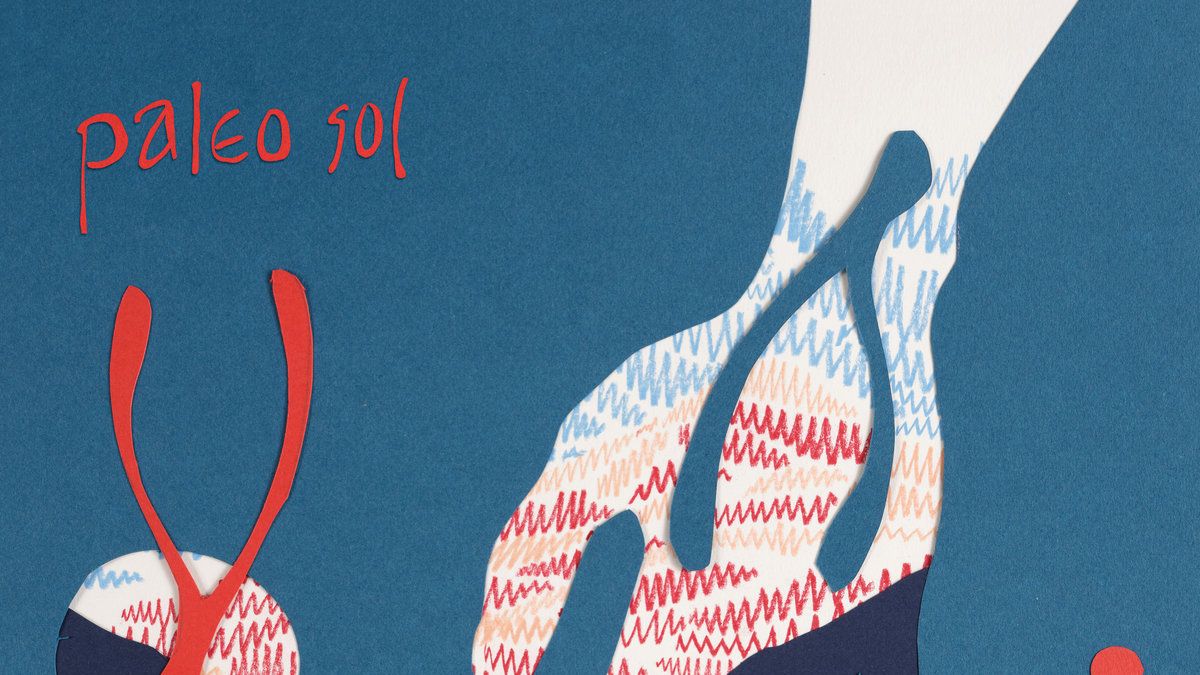
The “tectonic pedal steel” guitar of Barry Walker Jr. might be the definitive sound of the latter-day ambient country wave. His bends and sighs can be heard on records from Mouth Painter, North Americans, the Rose City Band and Jeffrey Silverstein, not to mention a string of solo albums both alone and with various bands (the post-rocking Tanks, the more sedate Unit). Meanwhile, his daytime trade as a geologist brought him from his home turf near Nashville to the Pacific Northwest, that rugged place whose seismic activity seems to thrum like the gears of a great subconscious. It’s safe to say country music is in his blood—and so, one can imagine, are the seams of magma that crisscross the Ring of Fire. His new album Paleo Sol is like a seance with the elements.
Paleo Sol comes on the heels of Live at the 13th Moon Gravity Well, recorded with the Unit at a Portland watering hole. Those four long improvisations were like offerings to placate the spirits of the still-rumbling Mount St. Helens, whose catastrophic 1980 eruption was the first of its magnitude to be studied with modern instruments. The tracks here are shorter, often resembling the plangent interludes one finds studded across Boards of Canada albums, but dressed up in Western wear. Still, there’s an unsettling calm, an attunement to the fragile truce between humankind and the capricious planet that nourishes it. It’s an awareness anyone who’s lived in Oregon can tell you all about.
No score yet, be the first to add.
Paleo Sol was recorded with a stripped-down combo: Walker on pedal steel and electric and acoustic guitars, with regular collaborators Jason Willmon on bass and Rob Smith on drums. Walker sometimes sings on record, but here he lets his instruments do the talking: thick sheets of pedal-steel gauze, overlaid with dew droplets of guitar that sometimes set a bucolic atmosphere (“Quiessence”) and at other times bend and moan with the portentousness of the Indian master Zia Mohiuddin Dagar’s rudra veena (the 12-minute “Sentient Lithosphere”). His backing musicians kick up dust, eschewing the post-rock pomp favored by his contemporary Chuck Johnson in favor of riverine structures that reflect the geologic time scale Walker wanted to capture here.
This is not complicated or challenging music, and at times the chord progressions are simple enough to make one yearn for a bit more spikiness. “Peridot, Call Me” is a vamp on I and IV, the stuff of millions of jams, and to be honest, there’s not much here that couldn’t be improvised in one take by a group of sufficiently locked-in musicians. But those sounds go a long way. Willmon’s basslines wind like the serpentine crooks of a subterranean river, Smith is skilled in the post-rock/post-Sunny Murray tradition of creating a bed for improvisation, and Walker is simply as good as anyone since Daniel Lanois at transplanting the wide-open sounds of the pedal steel into an ambient context.
Daniel D`Amico for SANREMO.FM