
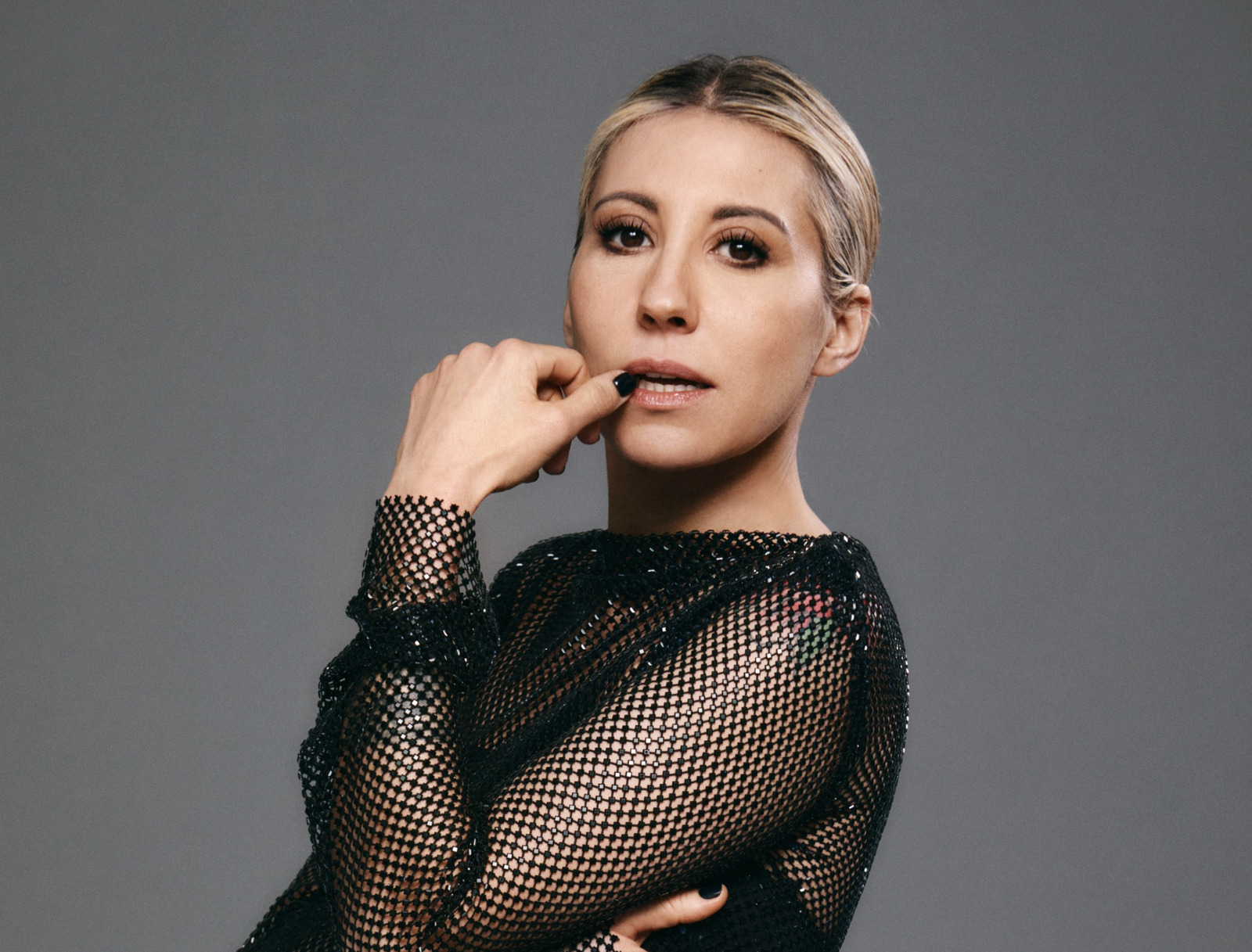
At Circle Milano, a chic bar in via Stendhal, which seems to have been created specifically to muffle the background noise of the city, we meet Malika Ayane after the press conference which anticipates her participation in the Sanremo 2026 competition and a busy round of interviews. When she understands that cameras won't be needed with us, she relaxes, takes off her heels (“how nice to be back in slippers”), sits on a sofa, orders a long coffee and sips it, calmly enjoying every sip. A clear break from the festival flow in which it is immersed.
We point out to her that it will be her sixth Sanremo, but the idea of being at a very definitive stage in her career doesn't convince her: «I'm still waiting for the maturity stage», she begins, almost as if to dismantle the narrative that provides obligatory labels for the various participations. Every Festival is different for her but this one, «thanks to the last one experienced in full Covid five years ago», reminds her of her debut in 2009: «Same desire and same lightness. With one difference: today the weight of judgment doesn't interest me. Anyone who doesn't like me will never like me. And I can say who cares.”
In 2010, with I'll start again from herethis distancing did not yet exist. But after fifth place in the rankings, the orchestra tearing up its scores in protest remained one of the most anomalous moments of the Festival. And she remembers it with a broad smile and not a little satisfaction: «It was something really punk». Also because that song, he specifies, «was based on an odd tempo, with an arrangement by Vince Mendoza, with lyrics about the conscious end. It contained a number of anti-cliché elements. I had also rejected important authors to try to tell my story firsthand. I played it and it went well. And that gesture made me feel better.”
Photo: Press
Long before Sanremo, however, we return to his training which had nothing pop about it: the children's choir of the Teatro alla Scala, the Conservatory chosen for practical reasons (“the civic schools were expensive, the Conservatory more accessible and the instruments could be rented”). And completely different music in my head: «In the bedroom I listened to Radiohead and went dancing at Space in Corvetto». She didn't want to be a classical musician, but that training gave her a solid foundation: “What I know about music I learned there.” For a while, given that her family told her “study music but get a job”, she even thought about a career as a chorister: “When I realized that the chorister worked consistently and received a salary, it seemed like an excellent deal.”
The past also resurfaces when we show her the photo of the closed Trottoir, one of the symbolic venues on the Darsena where she started performing: «I saw it last night, it was a shock». Not only for her personal story, but for how the city in which she grew up has changed: «I'm sad to think that on the Navigli the clubs could pay different musicians and instead use random playlists». The issue is complex, “it concerns licenses”, but in general “it is a great shame”.
He reserves the same ambivalent gaze for fluid music on platforms: “It was a great fortune to live in the era of gold and platinum records, when people still went to buy them in shops.” She remembers when she, «young and penniless», after reading the reviews «I downloaded music with eMule and then skipped meals to go buy records at Virgin.” Today, fluidity is considered both an opportunity and a limitation: “It is much more difficult for the listener to pay attention.” If he had started today, he adds, everything would have been more complicated: «Back then it was enough to catch a song on the radio and you could build something lasting. Today there are fragmented phenomena.”
Nocturnal animalsthe song with which he returns to Sanremo, is born precisely from this overabundance: «It talks about choosing among a multitude. It is the greatest form of self-determination and lightness.” The problem for her, in fact, is not the lack of options, but the difficulty of delving deeper: “Everything arrives at the same temperature and expires quickly.” On her experience as a judge on And even more ready to criticize: «In the hearings I was severe. Not in live shows, because I didn't want to mortify them.” But what struck her was the determination, “the hair on her stomach”, without the anxieties of her generation: “I said to one of the competitors who was talented: 'Retire, take three years to study and I'll give you a hand.' But he wanted to continue and immediately release a single.”
When we broaden the discussion to the political and social climate, Malika refuses simplifications. “There is no longer a majority,” he says, but “a constellation of positions.” This is why he sees a new awareness in young people: «In addition to the demonstrations, I was struck by the boycotts. They give up many things, not like us who demonstrated against globalization and then, in many cases, went to McDonald's to eat cheeseburgers for one euro. Today young people are not as scoundrels as they are made out to be.” But immediately afterwards, due to the various “bubbles”, he compares the present to the Seventies: «There is too much polarization. If a dialogue is not found, clashes are unfortunately inevitable.”
Also against the current on the freedom of expression of artists. We mention the controversy triggered by Ghali's live performance at the opening ceremony of the Olympics, with the Sports Minister warning him not to express his thoughts: «It was a performance of devastating power, broadcast by all the televisions in the world. I was at the stadium. Ghali was there, wasn't he? In fact, for Malika, controversies are a sign opposite to censorship: «If every day we have a different controversy it is because we are lucky enough to be European. And we should have a much more rooted European conscience. As long as we can talk about it, it means that freedom is guaranteed.”
His thoughts on the Eurovision issue raised by Levante are of the same tenor, which in the event of victory has announced that it will not participate given the presence of Israel. Her family history, Malika underlines, is crossed by different identities, which is why she doesn't want to reduce everything to binary positions: «An artist must bring messages of union. And confusing an individual with a state is a mistake. «Boycotting an event due to the presence of an artist, based only on his nationality, is the opposite of what we would like as justice towards those who are oppressed. Also because we don't even know who the artist who will represent Israel is. And we don't know whether he is a supporter or an opponent of the Israeli government. How can we boycott it a priori? Continuing to foment hatred and confusing the individual with a nation seems wrong to me.”
In this regard, he tells us about an episode that happened in France. He was on the radio with director Michel Gondry and «the hosts broadcast an excerpt from Iva Zanicchi which told the story of the bunga bunga». Once finished, they ask her: “You are Italian, are you all of this?”. The reaction is that of someone pulled into something they have nothing to do with: «I didn't know how to respond. It was funny, but it was also a truly absurd moment which makes us understand quite well the effects of when we lump everything together on a topic.”
Finally, before saying goodbye, he explained to us why he chose duets in the evening You burst into my heartan evergreen piece by Mina, in collaboration with Claudio Santamaria. A decision that she herself defines as “crazy”. But it is in this “pure unconsciousness”, on a “very emotional” song, that he finds certainties: “We can do great things on great emotions”.