
O
n Jan. 5, Tekashi 6ix9ine was driving with his sunroof open, enjoying his last full day of fresh air and blue sky before surrendering to authorities to begin serving his three-month sentence in New York’s Metropolitan Detention Center. The rapper, born Daniel Hernandez, was familiar with the Brooklyn jail; he’d been held there multiple times before, including recently in 2024.
“Remember when I told you that I was arrested, I was in prison with Diddy, the president of Honduras, and Sam Bankman-Fried,” Hernandez told his fans, on a video he later posted to Instagram. “And you guys thought I was lying?
“Now, I’m about to go meet the president of Venezuela,” he continued, referring to Nicolas Maduro, who is currently being detained at MDC. “I have that luck of just being locked up with presidents. Oh, and I’m about to meet Luigi, too — Luigi Mangione. About to play chess with them niggas, eat ramen noodles.”

Tekashi 6ix9ine is being held at the Metropolitan Detention Center in Brooklyn alongside made other big-name inmates.
Carmen Mandato/Getty Images
New York City’s main federal jail does not have the name recognition of Rikers, which is a state facility, but the recent slew of high-profile inmates has propelled MDC into the headlines. Along with Sean “Diddy” Combs, disgraced FTX founder Sam Bankman-Fried, and accused UnitedHealthcare CEO shooter Mangione, recent inmates include R. Kelly, Ghislaine Maxwell, and Martin Shkreli.
In January, Venezuelan dictator Nicolas Maduro and his wife, Cilia Flores, were taken to MDC after being arrested in a middle-of-the-night raid, prompting international attention and a slew of memes and AI-generated GIFs of Maduro hanging out with Combs behind bars. (In fact, Combs is no longer at MDC — he was moved to FCI Fort Dix in October to finish out his four-year sentence.) Some on social media have joked MDC is the real-life Arkham Asylum, a reference to the fictional psychiatric hospital that houses villains from Batman’s Gotham City. Others question whether MDC is partly a celebrity jail, in which VIP inmates are sectioned off and treated more luxuriously than others.
The truth is, MDC has historically been known not for the inmates it houses, but for the horrific conditions inside the jail. Most of the inmates are awaiting their trials and sentencing, with only a small percentage serving time after being found guilty. The federal detention center is famous for its extended lockdowns, lack of outside space, poor medical care, and violent brawls — it’s known for being cruel even when compared to other jails. Multiple federal judges have declined to send their defendants there and one lawyer, whose 36-year-old client died after he was injured in a fight while incarcerated, referred to MDC as “hell on earth.”
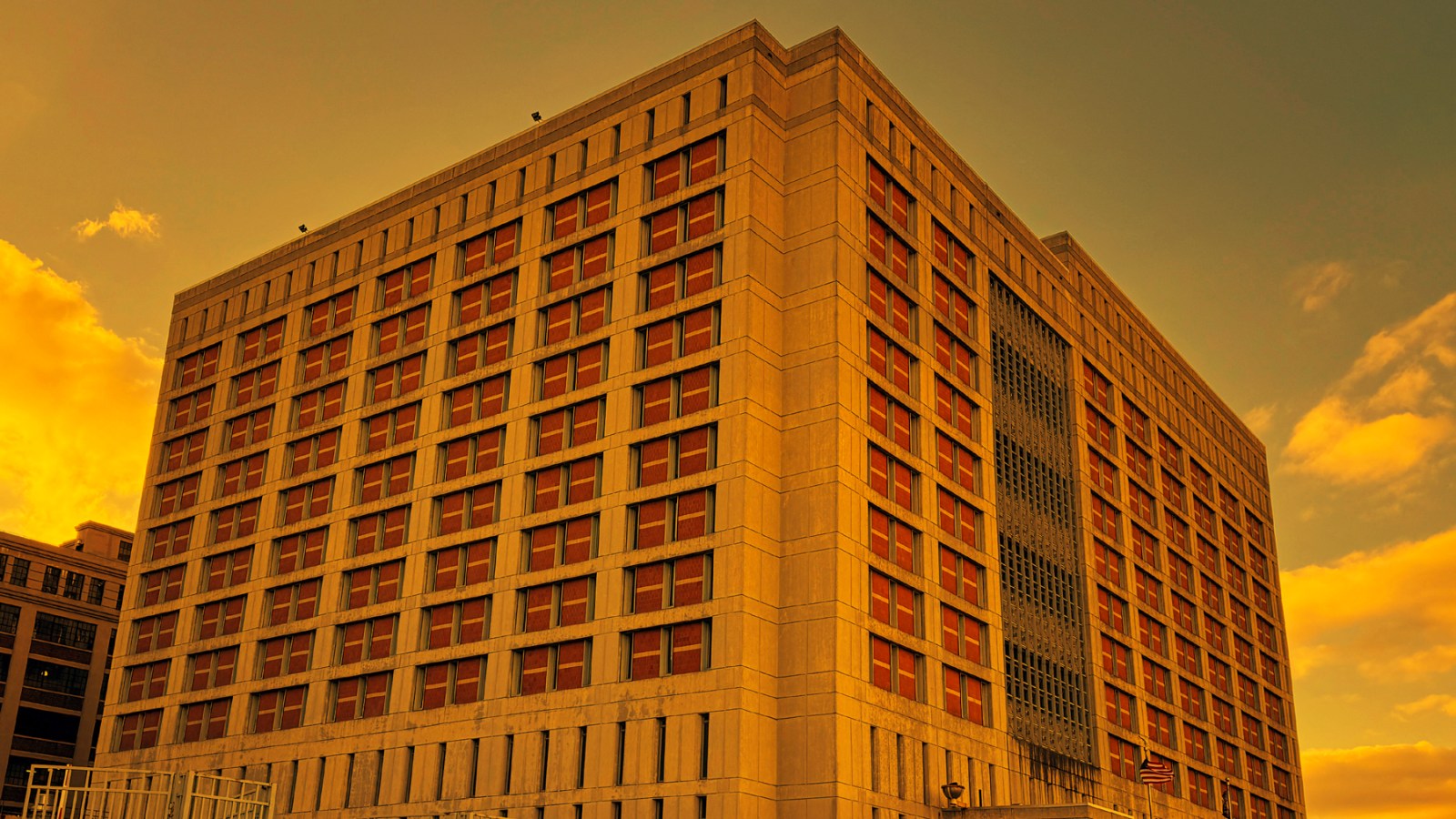
MDC IS A HULKING CONCRETE-AND-BRICK structure that sits between the Gowanus Canal and the Brooklyn-Queens Expressway. On a recent dreary January afternoon, correctional officers patrol the outside, and passersby catch the sulphuric scent of the nearby waterway. The Federal Bureau of Prisons logo adorns the building, advertising “NOW HIRING.” Directly across from the jail, shoppers walk in and out of the home goods big-box chain Floor & Decor with tile samples, and children climb a rock wall inside Industry City mall.
“There is nothing special going on at MDC; it is not a ‘Club Fed’ or privileged type of prison,” says criminologist Craig Rothfeld. “It is just one of those moments in time where you have many more high-profile individuals being indicted in the Southern District of New York,” versus other New York federal districts. (State crimes violate local laws whereas federal crimes involve breaking a federal law, or involve a crime that occurs across states like terrorism, tax evasion, or drug trafficking. People are sent to MDC from the Southern and Eastern Districts of New York — which comprise 13 counties, including all five boroughs.)
Rothfeld runs the prison consulting business Inside Outside Ltd. and has worked with clients like Mangione, NXIVM cult leader Keith Raniere, and Harvey Weinstein (who is at Rikers) to advise them while they serve their time. He explains how to interact with other inmates as well as prison officials, and how to request items like necessary medical equipment. Formerly incarcerated himself, Rothfeld says he now “mitigates, advocates, and solves problems for incarcerated individuals and their loved ones to help them navigate through arguably the worst period of time in their lives.”

Luigi Mangione, the suspect indicted in the murder of UnitedHealthcare CEO Brian Thompson, is seen after being extradited in 2024.
XNY/Star Max/GC Images
MDC is made up of two buildings that currently house about 1,300 inmates, most of whom are awaiting trial or sentencing. (Last year, MDC also began housing ICE detainees.) Inmates in both the east and west buildings are served the same food, subject to lockdowns, and given the same amount of time to spend on the pay phones — 500 minutes a month with calls limited to 15 minutes each, and a waiting time of one hour between calls. (For comparison’s sake, in New York state jails, inmates have virtually unlimited free phone time from 7 a.m. to 10 p.m. Federal detention centers often have stricter phone policies.)
The majority of the inmates are housed in the west building, in two-person, eight-by-10 feet cells with minimal floor space, metal bunk beds, lockers, a fold-down desk and shelf, and a stainless steel combination sink-toilet, known as a comby. There are often 60 cells to a unit, 30 upstairs and 30 downstairs, meaning there can be about 120 people together in a unit sharing showers, public televisions, TVs, wall computers, and pay phones. The west building also contains multiple special housing units (SHU) that are high-security solitary confinement areas with 24-hour monitoring as well as the Special Administrative Measures (SAMS) unit, where inmates requiring very high security are held.
The east building houses women, including Maduro’s wife, Flores, and a cadre unit, meaning inmates who have been designated to serve their post-trial sentences at MDC and are often given jobs that allow them to move around more freely. The east building also contains the “4 North” unit, which can house about 20 high-profile inmates at a time. Rothfeld explains that these inmates have been deemed low security risks or need to be separated from the general population for their safety. Rather than containing two-person cells, the east building housing is dorm-style barracks, with a more open floor plan where multiple beds are placed next to each other. Combs and Bankman-Fried were both held in the 4 North unit at the same time and could have had beds next to each other in the same dorm. Tekashi 6ix9ine has said he also spent time in this unit with Combs, Bankman-Fried, and the former president of Honduras.

People take part in a demonstration against U.S. military action in Venezuela outside the MDC, where ousted Venezuelan President Nicolas Maduro is being held.
Kena Betancur/AFP/Getty Images
However, celebrity status is not what solely determines where inmates are assigned. There have been high-profile inmates like R. Kelly and luxury real estate brokers and brothers Oren and Tal Alexander, who were housed with the general population in the west building.
Rothfeld stresses that no matter what unit inmates are assigned to, the conditions in MDC are deplorable. “It’s not like some cushy setup. It’s the worst of the worst,” Rothfeld says. “Four North just happens to be the best of the worst.”
MDC opened in 1994 to try and help reduce overcrowding in Manhattan’s federal jail, Metropolitan Correctional Center. In 2021, the Bureau of Prisons permanently closed MCC, due to concerns about its conditions. This left MDC as the sole NYC facility for inmates awaiting arraignment and sentencing. But lawyers tell me MDC has as many problems as the shuttered MCC. The Justice Department has issued critical reports about the jail, following investigations into how inmates are treated.
In 2019, a former MDC warden told The New York Times that the jail was “one of the most troubled, if not the most troubled facility in the Bureau of Prisons.”
IN OCTOBER, PEOPLE ON SOCIAL MEDIA CIRCULATED a photo of Mangione, the prime suspect in the UnitedHealthcare CEO shooting, in an off-white T-shirt over a sweatshirt standing with four other similarly clad MDC inmates. He has the faintest of smiles as he stands in front of a red-tiled wall. Standing two people to the left of him, in white pants, is former Venezuelan general and military intelligence chief Hugo “El Pollo” Carvajal. Carvajal, who faces life in prison, has written a letter to President Donald Trump saying he wants to provide evidence about Venezuela’s politicians participating in criminal activity.

Nicolas Maduro is seen in handcuffs after landing at a Manhattan helipad en route to a federal courthouse in Manhattan.
XNY/Star Max/GC Images
As soon as Maduro was extradited from Venezuela to MDC, unsubstantiated rumors swirled on X that the president had already met and interacted with Mangione. It’s unclear where Marduro is currently being held within MDC, although typically high-profile inmates are held in solitary confinement when they first arrive. And since Carvajal could potentially be used as a key witness against Maduro, it’s unlikely they’d be housed in the same unit.
It’s a common misconception that all the high-profile inmates are housed together, making MDC some sort of special celebrity detention center. In reality, the explanation for why so many big names are all in there together is quite simple: It’s because it’s New York, explains criminal defense attorney Lance Clarke.
“We put all the people in that one place whether you rob the bodega or you’re Bernie Madoff,” says Clarke, who is based in Manhattan.
He explains that the Southern District of New York (SDNY) is known as the “Mother Court” in the United States — it’s the oldest federal court in the country, predating the Supreme Court — and often leads high-profile investigations that can involve extraditing people from all over the world, like Maduro. The SDNY started investigating Maduro for narco-terrorism in 2011, unsealing an indictment against him in 2022 and another one in 2026. Because the investigation began with the New York City court, Maduro was extradited to the NYC federal jail.
Brandon, a former inmate who served a year at MDC in 2024 and asked to use a pseudonym for anonymity, tells me it didn’t seem to him like high-profile inmates got special treatment. He says that even if some of the inmates are famous, there are people who are more popular than a celebrity because of their international status and power, like politicians or drug cartel leaders.
THE PEOPLE DETAINED AT MDC OFTEN don’t see the sky for weeks at a time. The little sunlight they get falls through small windows at the tops of a wall in the recreation center. When it’s cold, inmates stand in the squares of light, lifting their faces to the ceiling, to soak it in.
Brandon says that typical days are spent reading, working out, listening to music on tablets that can be purchased from the commissary, or watching movies available to rent. On the second Tuesday of each month, 10 new films are added to the rental queue and 10 are removed. The common area includes tables and chairs that are bolted down with TVs and access to computers mounted on the wall. Inmates play games like chess to pass the time. No internet access is allowed outside of the jail’s email system. There are some inmates who have jobs within the jail. Mangione, for example, has been assigned to clean the showers and bathrooms in his unit.
Some detainees who are held for years before their trial only breathe open air in the brief moments getting in and out of the prison van while being transported to and from court.
“You’re not breathing fresh air,” says Brandon, who adds that the windows are so small it’s sometimes hard to tell whether it’s day or night.
The lack of access to fresh air is what makes MDC distinct from other federal prisons, where inmates are typically allowed an hour a day in outside yards. Brandon says the indoor rec centers resemble a high school gym, a square contained by four walls, only one with a window, with nothing inside but a basketball court.
“You got to go to the box to get fresh air,” says Brandon, referring to the solitary confinement units on the eighth floor. He explains that on that floor, the rec center is outside. “It’s a little cube with a cage around it, like a dog cage. You can look up and see the sky, if it’s raining you could feel the rain.”
But Brandon explains nobody wants to be in solitary confinement, where conditions are even worse than in general population. Sometimes, correctional officers leave the lights on in the tight cell for days, and if they perceive an inmate as having an attitude, Brandon says they use pepper spray through a slot in the cell door. (The Bureau of Prisons didn’t respond to a request to comment about this specific allegation.)
R. Kelly, who was found guilty of sex trafficking and racketeering charges in September 2021 and was held in MDC from June 2021 to July 2022, sued MDC in 2022 for placing him on suicide watch for what his lawyer claimed were “purely punitive reasons” that violated his Eighth Amendment rights because it was “cruel and unusual punishment.”
Kelly’s 2022 lawsuit stated, “They cannot shower or shave and are sometimes not even afforded toilet paper. Meals are not provided with utensils, forcing inmates to eat with their hands. They have no ability to consult with loved ones or supportive figures. Ironically, individuals on ‘suicide watch’ don’t even receive psychiatric care.”
The Bureau of Prisons said at the time that a staff psychologist placed Kelly on suicide watch after he was sentenced to 30 years in prison. When Rolling Stone reached out for comment on the multiple allegations about the conditions at MDC, they responded in an email that, “for privacy, safety, and security reasons” they could not speak about internal procedures, anecdotal allegations, or conditions of confinement. A public affairs representative added: “MDC Brooklyn takes seriously our duty to protect the individuals entrusted to our custody, as well as maintain the safety of correctional employees and the community. We make every effort to ensure the physical safety and health of the individuals confined to our facilities through a controlled environment that is secure and humane.”
There have been a series of lawsuits against the detention center for inhumane conditions, particularly during the Covid pandemic. At least three federal judges in recent years have refused to send defendants to MDC because of the conditions and frequent lockdowns, which can leave inmates in their cells for days at a time with no access to showers. In January 2024, federal judge Jesse Furman issued a 19-page decision about MDC’s conditions, citing a case in which the jail had refused to transport an inmate for surgery to repair his cheekbone, which another inmate had broken in a fight. The defendant had to have his cheek rebroken ahead of his surgery in order to heal properly.

In 2019, inmates bang on windows inside MDC as a protest about the facility’s conditions takes place outside.
Yana Paskova/The New York Times
In August 2024, a federal judge from the Eastern District of New York said he’d identified “shocking instances of brutal violence” within MDC in just the previous five months, including two homicides, two stabbings, and an assault resulting in fractured eye socket. He highlighted an incident where three inmates stabbed another inmate 44 times in an “open area without supervision,” and the judge wrote the response to the event took an “unconscionably long time.”
Just this past December, an inmate died in custody after MDC’s medical staff missed a lung cancer diagnosis for an inmate complaining of chest pain. A jail doctor ordered a CT scan in early November 2023, and the test was delayed for months. The inmate wasn’t told about the mass the CT found until the end of April 2024, after he was already coughing up blood and had repeatedly requested his test results.
“The results were somehow missed by the health services department, and the delay was unfortunate,” the medical staff wrote in response to the missed diagnosis.
Criminal defense attorney Anna Estevao says there have been multiple accounts of fatal medical diagnoses being missed. “The MDC has a long and documented history of inhumane conditions, including chronic overcrowding, severe understaffing, and woefully inadequate medical care,” Estevao tells me. She adds there have also been repeated reports of maggot-infested meals, and recently an inmate had to be treated medically for choking on a piece of plastic in his food.
Brandon says meals are served cold and often reused and repeated for days. “It’s like if you take the chopped meat out of a taco from Taco Bell, rinse it off with water, leave it sitting in water for days and then put some gravy on it or add beans and then serve it,” he says. “Then the next day you have the beans and gravy in it, and you just put corn in and serve it again.”
The Bureau of Prisons did not specifically respond to our request for comment on their food, but in the past they have cited their manual and said MDC “provides nutritionally adequate meals, prepared and served in a manner that meets established government health and safety codes.” They did previously admit in a court document that they’d found weevils in their beans.
Combs’ lawyers said he was threatened by an inmate with a shiv once. And Clarke says he’s gone to see clients whose entire faces have changed from one visit to another because of the violent fights. Clarke says, “What people experience at MDC, it’s not just punishment, it’s neglect, chronic understaffing, systematic failure, dehumanization.”
Rothfeld agrees. He won’t comment on any specifics regarding his clients, but he’s worked with people housed in both the east and west buildings of MDC as well as other facilities like Rikers, where he was held in 2016-17 for financial crimes. He believes “blame doesn’t rest with the employees” and staff at MDC, it’s a larger problem that needs systemic solutions. For several years, the Department of Justice’s Office of Inspector General has issued reports about the challenges at the Federal Bureau of Prisons, including “staffing shortages and deteriorating infrastructure.”
“The prison system in general, whether federal or state, is a Byzantine black hole,” says Rothfeld, but he finds MDC particularly “draconian, cruel, and unsanitary.”
ON JAN. 6, HERNANDEZ livestreamed his last two hours of freedom with his friends on Adin Ross’ YouTube channel. He joked to the controversial streamer he wanted to cook for Maduro, saying he would make him “spaghetti tacos.”
Hernandez and his friends tried to keep it light as they took a limo to Sunset Park, belting out Justin Bieber’s “Baby” and “Hold On” by Lil Tjay. Hernandez said he plans to read the Bible in prison, and will try to work out and lose weight.
As they got closer, the mood changed. Hernandez got on the phone with someone and said in Spanish that he understands he’s going to be in solitary his first week and that he’s prepared for it.
At 2 p.m., the rapper arrived at MDC to start serving the 90 days for violating the terms of his supervised release following his plea deal in the federal racketeering and firearms case. Hernandez’s friends turned solemn after he walked into the hulking concrete detention center.
“That’s actually so fucking sad,” Ross said to the camera as he started to get emotional and sign off. “That’s horrible, bro. It fucking breaks my heart.”
Daniel D`Amico for SANREMO.FM