
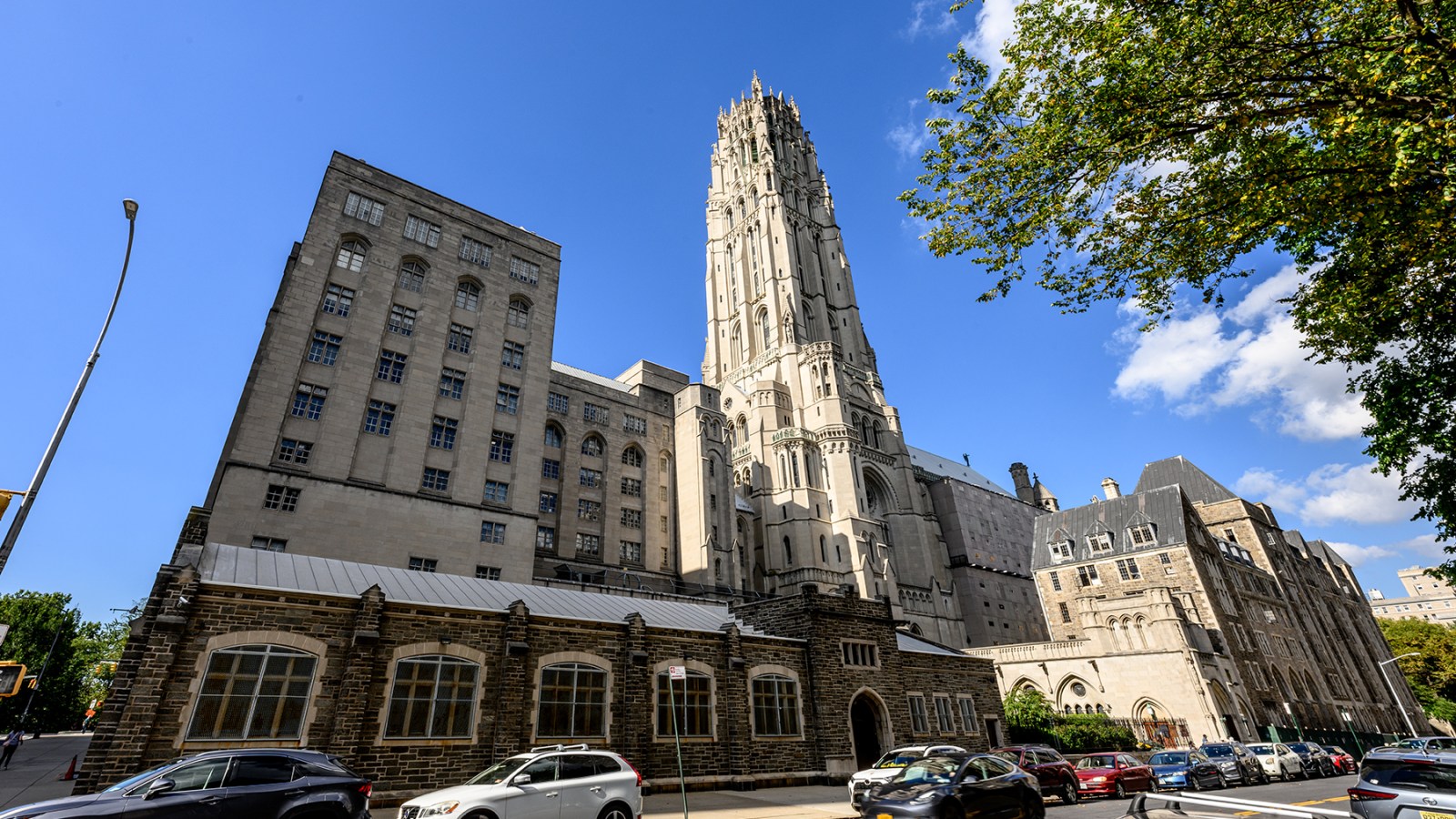
The case of Daryl Powell, the first former basketball player to take New York's Riverside Church to trial for childhood sexual abuse, nearly wrapped on Tuesday, as attorneys supplemented victims' accounts with testimony from former coaches, a psychiatric expert, and a paper trail attempting to show the vaunted institution's culpability.
In the most disturbing development of the week, a former Riverside assistant coach testified Monday that he left his job in 1985 after walking in on the program's multimillionaire director, Ernest Lorch, with a young player who had his shorts pulled down to his knees. On his way out, coach Deron “Sheeb” Johnson testified, he ran into a pastor at the church, asking him, “Do you know what's going with the kids in your program?”
Riverside's attorneys, meanwhile, began to flesh out their defense before the six-person jury in lower Manhattan. In cross-examination of plaintiff witnesses, Riverside counsel Philip Anchevivo sought to sow doubt about the credibility of those testifying to events alleged to have happened a half-century ago, while hinting that Powell hasn't incurred damages from his time with the church's vaunted basketball program.
Powell is one of 27 plaintiffs alleging in civil suits that Riverside ignored four decades of abuse by Lorch, detailed in a joint investigation by Rolling Stone and Sporty. Powell, 64, is the first to see his state Supreme Court case go to trial under New York's 2019 Child Victims Act.
The trial is expected to conclude early next week. After some additional plaintiffs' depositions are read into the record on Wednesday, Powell and his legal team will watch Riverside attorneys try to convince the jury that only Lorch, and not the Rockefeller-funded church, was to blame for what Powell says happened to him in the 1970s. Powell's claims include Lorch routinely paddling the then-teenage player on his bare backside, and groping and fondling his genitals during regular “jockstrap checks.”
Lorch died in 2012, 51 years after the corporate attorney and finance executive began building Riverside's program into an NBA talent pipeline and prototype for today's lucrative youth sports industry. He was forced out of the program in 2002 when another former player and current plaintiff, Robert Holmes, publicly accused him of abusing him as a child and paying him millions of dollars for his silence as an adult.
The trial opened last week with dramatic testimony from Powell and two former teammates, Mitchell Shuler and Byron Walker, who also alleged Lorch abused them. This week, the jury in Judge Alexander Tisch's courtroom heard Johnson and another ex-coach, James “Turtle” Williams, testify to leaving the Riverside program because of Lorch's manner around the youth players. “The vibes, they weren't right,” Williams said. “The touching, the looking down your pants, I was never with that.”
Under questioning from Powell attorney Paul Mones, they also testified that Lorch's predation was common knowledge in basketball circles and the broader community, with Williams referring to Lorch as “a 'P5'”—his slang term for a “pervert.”
After encountering Lorch and the player with his shorts pulled down, Johnson said he immediately rounded up two dozen young players on the teams he coached and marched them from Riverside's basement gym, never to return. “I told my kids, 'We're out.” He added that Riverside players felt that if Lorch “had you alone, anything was liable to happen, sexually.”
While the victim and witness testimony about Lorch's harassment has often been wrenching, an important factor will be whether the jury finds Riverside's institutional neglect was to blame for the abuse. In opening statements last week, Anchevivo contended the church had no way of knowing about the abuse, and that Lorch was an unpaid church volunteer who bore all the responsibility for any wrongdoing.
Trying to counter that argument, another of Powell's attorneys, Lawrence Luttrell, walked the jury through dozens of documents this week while questioning Natalie Fein, the church's chief operations officer. Luttrell pushed the idea that Lorch and his basketball program were well-known to the church.
Luttrell presented multiple issues of the church newsletter, The Carillon, containing articles from the 1960s, seventies, and eighties, highlighting the success of Lorch and the Riverside Hawks teams. The side plaintiffs also pointed to official Riverside records to depict Lorch as “a prominent member” in the church hierarchy, based on his leadership roles on multiple church committees and executive titles on the board of deacons and board of trustees.
Under questioning from Luttrell, Fein, who has only been with Riverside since 2022, agreed with the attorney that infrastructure of the basketball program — from gym maintenance to heating costs to the water in the locker room showers — would have been paid for by the church, and that the program could be considered a part of the institution.
“Riverside church solely decides who may supervise children on the property, correct?” Luttrell asked. “Correct,” Fein answered.
Luttrell got Fein to agree with his assertion that “you would have to get authority from the church to access its facilities,” and that no “outside organization” could grant access.
Powell's attorney also drew a contrast between oversight of the basketball program — where there did not appear to be a single document referring to its management during Lorch's tenure — with the detailed written guidelines for the 1969 launch of a church infant day-care center.
Throughout Monday's and Tuesday's proceedings, Anchevivo challenged the credibility of the plaintiffs' assertions. He questioned why Johnson and Williams, the assistant coaches, did not tell authorities when they saw or suspected wrongdoing — and brought up Johnson's history of illegally selling drugs while he was a coach.
He also asked why they agreed to work for Lorch in the first place if they heard rumors of his reputation. Both replied that Riverside's elite status could advance the prospects of the players they brought to the program, and that the $300 a week Lorch paid them in the mid-1980s was good money at that time.
It fits with Anchevivo's cross-examination of Powell last week, where he questioned why Powell never reported Lorch's abuse to authorities until his lawsuit. He also asked why the former player alleged as many as 420 incidents of abuse on the stand last week while only claiming “more than 10” incidents in his 2023 sworn deposition for the case.
That pattern continued Tuesday in his cross-examination of Powell's expert witness, Dr. Anthony Charuvastra. A psychiatrist who specializes in trauma from childhood abuse, Charuvastra discussed his examination of Powell last September, and testified that he believed Powell suffers from post-traumatic stress disorder and chronic low-level depression.
Under questioning from Mones, Charuvastra testified that while Powell has been able to function successfully in his job as a deputy sheriff in Virginia, he's “always felt a sense of mistrust” and “a fear of being violated,” in large part as a result of the abuse by Lorch. He told of how Powell sleeps at night with long underwear and shorts because of that fear.
Like many firefighters, police, and service members with PTSD resulting from trauma, Charuvastra said, Powell “is suffering,” but he's able to keep it “separate from his public-facing persona.” The disorders, however, hurt Powell in his private life with women and personal relationships, the doctor said.
Anchevivo questioned the diagnosis, contrasting it with an earlier counselor's report that said Powell was “high-functioning.” He also brought up Powell's successes during and shortly after his tenure with Riverside, where he made all-New York City as a power forward at DeWitt Clinton High School and starred in three years of college ball while completing course work.
The Riverside attorney also questioned whether it was Lorch's actions that led to Powell's trauma. Powell testified to being sexually assaulted by a knife-wielding stranger when he was 10 years old, and Anchevivo hinted that Charuvastra, who was paid by the plaintiffs' attorneys for Powell's exam, was downplaying that as a factor.
The doctor said the two incidents were both important, and that Lorch's extended pattern of abuse —from a trusted “father figure” — compounded the trauma of the earlier incident.