
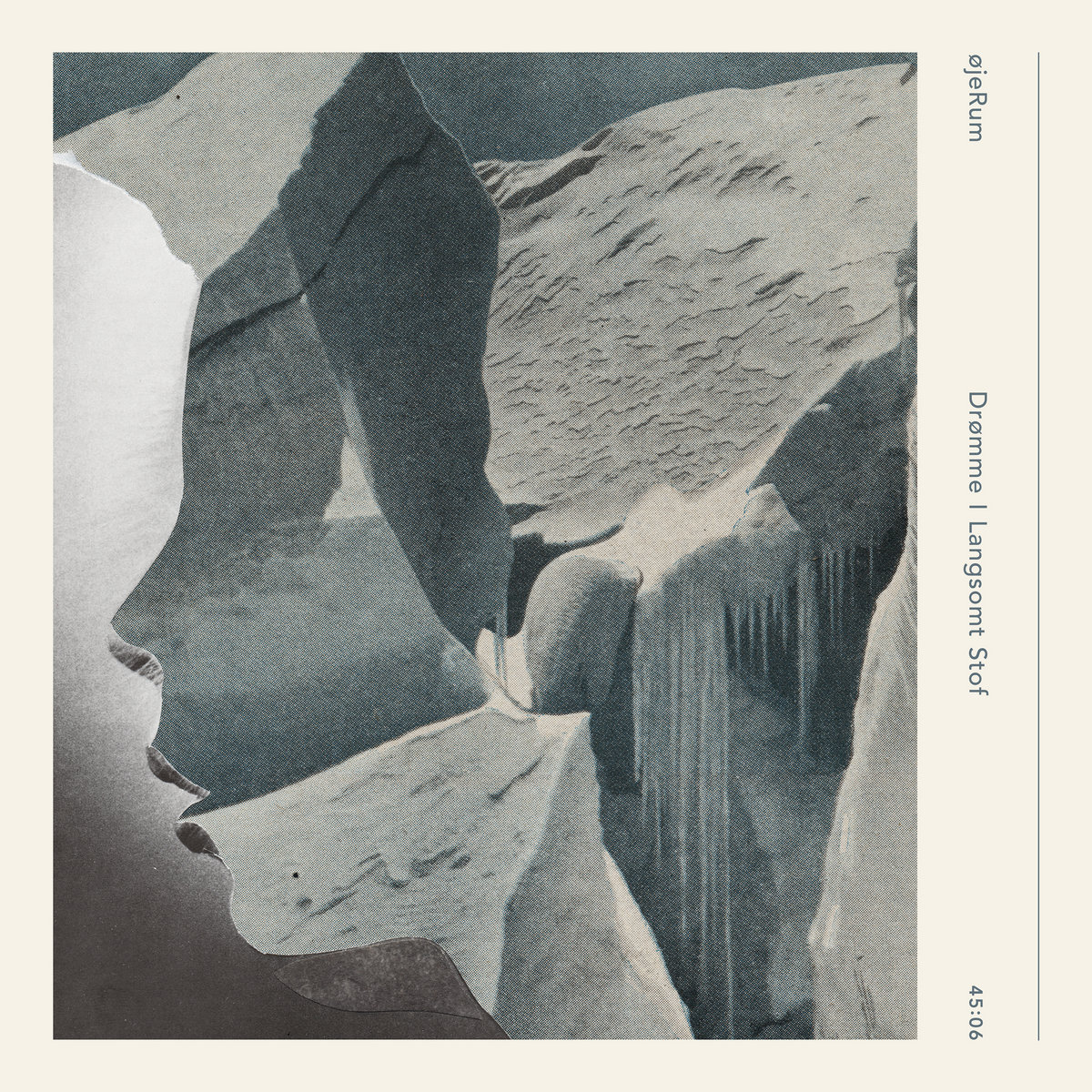
What would happen if suddenly the sound of melting glaciers was amplified and became audible in our cities, in our homes, in our earphones? Would our lives continue the same or would something revolutionary happen? Paw Grabowski, author of the OjeRum project, starts precisely from this question and from the awareness that Western society lives immersed in a perceptive bubble: what cannot be seen or heard directly is removed, anesthetized, made abstract. To break this silence, Grabowski makes a simple but very powerful gesture: he amplifies the real sound of the melting of a frozen lake and transforms it into a conceptual work of field recording which is, first of all, a political act.
The result is “Drømme I Langsomt Stof”, forty-five minutes that become a radical warning: the world is changing before our eyes, but we don't want to listen to it. The work probably won't reach the masses and won't change collective behavior, but “Drømme I Langsomt Stof” does what authentic art should always do: break down indifference, offer new tools of perception, make audible what our selfishness tends to silence.
Grabowski records the sounds of the ice sheets that slowly give way, shatter, melt, and superimposes them on an almost immobile, ritualistic and disturbing hypnotic synth mantra. The sonic evolution accompanies the physical passage of water: from compact ice to silent and inevitable liquidity. Time is slow, inhuman, opposed to the accelerated rhythms of production and consumption. Here lies the political power of the work: the song forces us to feel the decay without reassuring filters.
It is an implicit but very harsh criticism of the indifference of a world which, like the Nazi family in the novel and film “The Zone of Interest”, lives alongside the catastrophe pretending that it does not concern them, as if the sound of the end were just a distant background noise. Grabowski, by amplifying the actual sound of a dying glacier, strips away that filter.
“Drømme I Langsomt Stof” thus becomes a fundamental piece in the history of music field recording: it is not just an aesthetic operation, but an act of resistance against our sensorial and moral anesthesia. It is a work that is more philosophical than musical, but precisely for this reason it is revealing: like the black glasses in “They Live” by John Carpenter, it forces us to see and listen, in the hope – probably vain – that art can save the world.
07/10/2025
Antonio Santini for SANREMO.FM