

Those who read “Vicolo del Mortaio”, the 1947 masterpiece with which Nagib Mahfuz delivered Cairo to the history of literature, will not easily forget the character of Hamida: altered, insecure, passionate, in his tin of contradictions the complexity of adolescence and femininity is mirrored. Nadah el Shazly I had imagined it not too dissimilar – and to judge by the performance That I'm about to tell you, maybe I didn't have all wrong.
A real gift, this free evening at the greenhouses of the Margherita Gardens, for which the Bolognese collective no glucose is thanked. The absence of toll may have contributed to recalling a more thick audience than expected, which does not seem to put the protagonist at ease, reduced to a hopping bundle of nerves. It looks like “Laini Tani”, his new album released in June: less ecstatic and contemplative than “Ahwar”, more fragmented and restless. Nervous, in fact. The dust of the Mediterranean metropolis is replaced by the alienation that we know all too well. In the middle there were the post-club Abrasiva di “Pollution Opera” and the chamber delicacy of “The Damned Don't Cry”, both last year. This fourth album, in his own way, looks for a compromise between the two extremes.
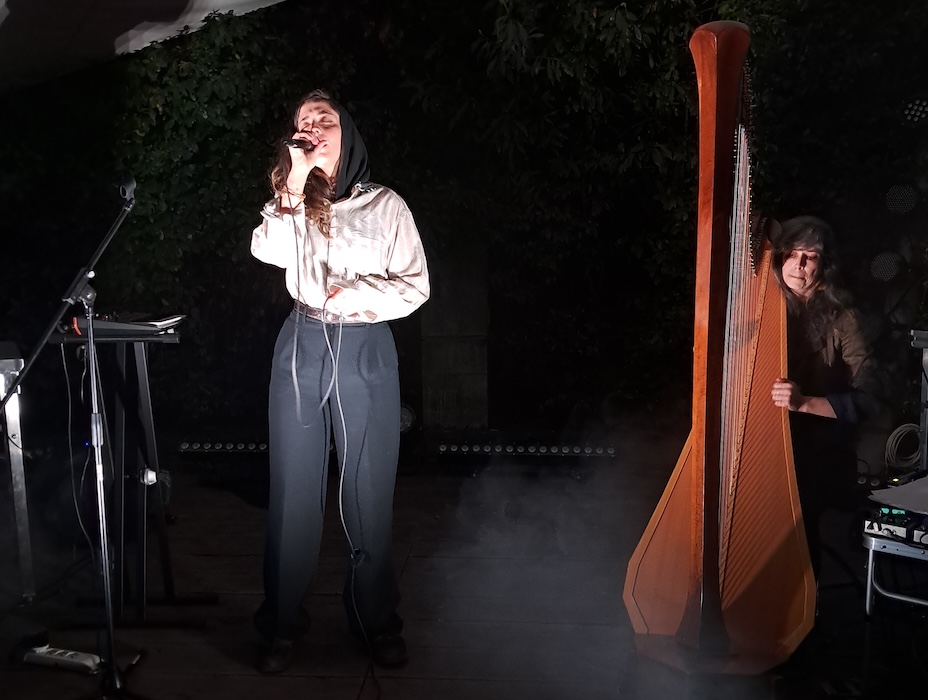
The low stage is a perfectly tripartite altarpiece: on the left, the laptop of Ismail Hosni; On the opposite side, the majestic harp of Sarah Pagé; Low eyes and wood movements, Nadah is unwillingly in the center. The look is Spartan, with a long skin coat to cover a striped shirt from which a hijab black. Throughout the performance, the veil will constitute the veil tic Predict of the singer, as if he absorbed a mysterious energy from such a powerful identity symbol.
The ladder will be entirely based on the songs of the new work, performed (almost) from top to bottom. “Elnadaha” gives himself his time to take altitude, with the interpreter who, gradually acquires safety and gestures that are less measured, until the two -handed microphone is grasped in the last verse. From there, the intensity of the concert will grow song after song.
It is with very deep, almost industrial bass of “Banit” that Nadah melts once and for all, and the public with her: one trance Climbing is implemented of the first rows, swaying in time with music that seems to enter and get out of an hypnagogical state. The psychedelic inks of “Eid” penetrate even more a depth and the minimal pendant of the singer becomes an account and then a clumsy dance, which forces her to get rid of the coat. On “Dafaa Robaai” it lowers and mechanically get up the veil, as if to ascertain from a malignant presence, while the ropes of the ARPA are pinched, beatings, scratched.
Only now do the first words arrive, who remain among the few. It informs us that the previous “Sweet Songs” were written in Montréal, the second home of the author, full of nostalgia for the beloved Egypt, but that now it is the time for “a typical freeform Mawal song”: “Laini Tani” is really and everything seems to want to undress of the swabs, starting from the colored lights on stage, reset to make room for a flat grip. Halfway to accompany the voice there is only the harp, gradually more dissonant, while Nadah massages the temples as in the grip of an emicranium, he throws suffering from melisms against the sky and then sinks his fingers on an acid synth like a bad memory, with the washing car wash of Ismail to work her hips, nailing suddenly as if the weather was frozen. There is a stucco, we stay.
Almost to be forgiven, “Labkha” part of the caresses, cradled by soft vocalizations, but then the psychosis falls here too, Nadah is pressed the diaphragm to squeeze out all the breath that remains, he reinforced the hungry of other oxygen, chunks out of the microphone, shine, pawing. It is difficult to recognize in such fury the shy fuscello of the first bars.
The second, tightened intervention lasts the presentation of the two companions, and then sentenced “this is the last track”. On other occasions he would have grumbled, a fly does not fly here.
“Ghorzetein” is the final bacchanal that it is legitimate to expect, between breakbeat Tribals, screams, razor of harp and another lacerating synth solo. “Shot!” (“Brava” in Arabic) An Egyptian girl screams next to me and for the first time a smile is printed in her face, not enough to convince her to stay on stage.
But just when the hopes were diminished, as if by magic the three reappear with what is presented to us as “the cover of an old song from 1925”: it is Sayed Darwish's “ana 'Ishiqt”, a noble father of Egyptian music, already faced on “Ahwar” and here made with the violence of a door beaten in the face, largely crushed by the microphone, interpreting the letter, interpreting the letter, Love frustration of the text.
Even more surprisingly, we find it shortly after the banquet of merchsucking borne from a thin cigarette from vamp. I try to exchange two words, but I am reciprocated with some hasty response and an impassive challenge look. All that remains is to leave her there, fragile and proud, like the unattainable Hamida who stole her heart from generations of readers.
Antonio Santini for SANREMO.FM